Most travelers booking a private villa picture the same worries: a door left unlocked, kids wandering near the pool after dark, an unfamiliar face at the gate. What they rarely know is what security a villa actually provides. Unlike a hotel with a front desk and cameras in every corridor, a villa’s protection depends on walls, gates, lighting and sometimes a single night guard, and the setup varies enormously from one property to the next.
This guide breaks down how villa security works in practice. We will look at what a typical security package covers, how gates and perimeter walls function, what night staff actually do during their shifts, where cameras and safes fit in, and why the pool, not the intruder, is usually the biggest risk after dark. We will finish with the exact questions to ask before you book, so you know precisely what you are paying for.
What Villa Security Actually Covers
Villa security is built in layers, and the first layer is almost always physical. A typical property has perimeter walls or fencing, a gate at the entrance, exterior lighting around the grounds and pool, and CCTV covering outdoor areas. Some villas add staff on top of that, either a guard at a shared entrance or night patrols inside the grounds.
The order of those layers matters. Private villas rely on barriers first: the wall keeps people out, the gate controls who enters, and the lighting removes the dark corners where someone could hide. Staff and cameras are secondary layers that support the physical setup, not replacements for it. A villa with a low, easily climbed wall and no self-locking gate is weak no matter how many cameras it has.
Standalone villas vs. staffed villa resorts
The scope of security differs sharply between the two main types of property. A standalone villa you rent privately usually has just the basics: walls, a gate you operate yourself, lighting and maybe a camera or two. There is no front desk and often no one on site overnight.
A staffed villa resort works more like a small hotel. These estates typically have a single staffed entrance plus CCTV at the gates and pool areas, and security personnel who log arrivals and patrol the grounds. Understanding which type you are booking tells you most of what you need to know about the protection on offer.
Gates, Walls and Perimeter Control
The gate is the single most important security feature at any villa, because it is the one point where everyone, welcome or not, has to pass through. How that gate is managed depends on the type of property you book.
Gated estates with a guardhouse
Larger villa estates are usually built around a single staffed entrance. A guardhouse sits at that entrance, and security staff log every vehicle in and out, note the time, and check that deliveries and taxis are expected. As a guest, you typically register your name and villa number on arrival, and after that the guards wave you through and turn away anyone who is not on the list. This is the closest a villa gets to hotel-style security, and it is one of the strongest arguments for choosing a gated estate.
Self-operated gates at standalone villas
Standalone villas usually leave gate duty to you. The most common setups are a key-code pad or a remote control that opens the gate from your car. Both work fine, but they shift responsibility to the guest: the gate only protects you if it is actually closed. When you view or research a villa, check three things. First, gate height, since a waist-high gate keeps out casual visitors but little else. Second, whether the perimeter walls are climbable, with nearby trees, planters or lattice making it easy to get over. Third, whether the gate self-locks at night or simply swings shut. A gate that needs to be manually bolted is only as good as the last person who remembered to bolt it.
Night Staff and Patrols
Once the sun goes down, security at a villa comes down to people, and the key question is whether anyone is actually awake and on the grounds. The answer varies more than most travelers expect.
What night guards actually do
At villa resorts, night security staff typically work shifts from roughly 10 pm to 6 am. Their job is straightforward: they patrol the grounds on foot, check that gates and pool areas are secure, and keep an eye on the entrances. If someone approaches the property at 2 am, the guard is the person who decides whether that is a lost taxi driver or a problem. Many larger resorts pair the guard with a night concierge, so guests can also call for late check-ins, extra towels or help with a lost key without waiting until morning.
When there is no one at all
Small private villas may have no night staff whatsoever. The day housekeeper or gardener goes home in the evening, and from then until morning the property relies entirely on its walls, gate and locks. That can be perfectly adequate in a quiet, well-lit, gated neighborhood, but it is a very different proposition from a staffed estate, and it changes how careful you need to be about locking up. The only way to know which situation you are walking into is to confirm before booking. Ask the owner or manager directly whether anyone is on site overnight, and treat a vague answer as a signal to ask more questions.
Cameras, Safes and Smart Locks
Cameras at a villa are there to watch the property, not you. Expect CCTV at the gate, along the driveway and around the pool area, and nowhere else. Bedrooms and bathrooms are legally off-limits, and a reputable owner will state this clearly. If you spot any camera inside living or sleeping spaces, treat it as a serious red flag and walk away.
Good owners should be able to answer three questions about their system: where the footage is stored, who can view it and how long it is kept. Storage is often a small recorder in a staff area or a cloud account, and retention is usually limited to a few days or weeks. You are not being difficult by asking; a host who hesitates on all three is telling you something about how they run the place.
Inside the villa, your main tool is the safe. Most in-villa safes are sized to hold valuables up to about 15-17 inches wide, which covers laptops, passports, cameras and spare cash. Code locks beat keys for a simple reason: keys get copied or lost, while a code stays with you. Change the code when you arrive if the owner allows it, and test the safe with something inexpensive before loading it up.
When comparing villas, check the details of the security setup rather than just the fact that one exists:
- Camera coverage: ask for the specific locations, so you know whether the driveway, pool and gate are all covered or only the entrance.
- Smart locks: some villas use keypad or app-based door locks, which let you change codes between stays and avoid handing keys to multiple people.
- Safe placement: a safe bolted into a wardrobe or wall is far harder to carry off than one that simply sits loose on a shelf.
- Backup power: ask whether cameras and locks keep working during an outage, which matters in destinations with unreliable electricity.
Pool Safety After Dark
The pool is where villa holidays and safety concerns genuinely collide. Almost every private villa pool is unsupervised, and lifeguards are rare even at luxury properties. At a resort, a poolside attendant is usually somewhere nearby; at a villa, the water is yours alone to manage, day and night.
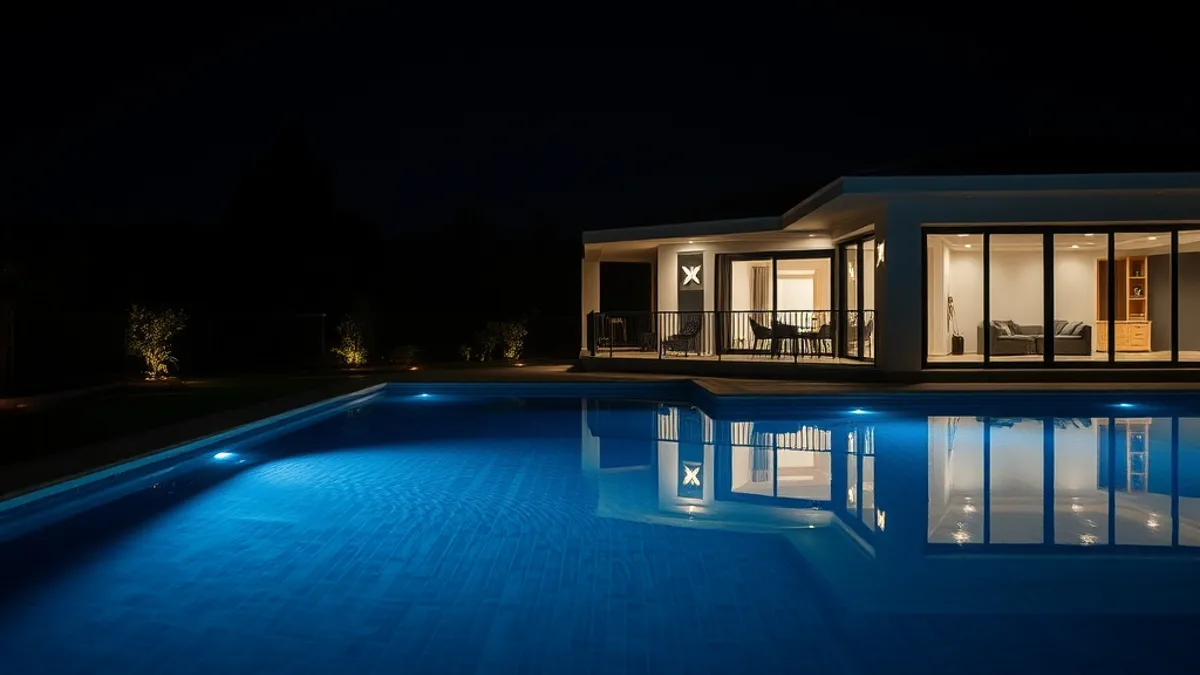
After dark, the risk grows. A dimly lit pool looks like still ground, and an adult who slips in can be in trouble before anyone hears a sound. Lighting around and in the water is not just ambiance; it is one of the most practical safety features a villa can have. When you look at photos before booking, check whether the pool area is clearly lit at night, not just pretty at sunset.
Physical barriers worth looking for
Pool fencing or removable pool gates are increasingly standard at family villas, and they are the single feature I would prioritize for anyone traveling with small children. A removable child gate lets adults use the pool freely while making it genuinely hard for a toddler to reach the water unattended. Pool alarms add another layer: some float on the surface and sound when the water is disturbed, while others mount on doors leading to the pool deck.
Rules you set yourself
Since no one else is watching, your own house rules carry the weight. Two are non-negotiable in my book: no one swims alone at night, and the doors between the villa and pool area stay locked from the inside once you turn in. Locking those doors also stops an open door from drawing kids toward the water while you sleep. Brief everyone on the first evening, including guests who think they don’t need telling, and the pool stays what it should be: the best part of the villa, not the most dangerous.
Questions to Ask Before You Book
Security features vary so much from one villa to the next that asking is the only reliable way to know what you’re actually getting. Two villas on the same street can sit at opposite ends of the security spectrum, so never assume anything from the listing photos. The good news is that this is a completely normal request, not an awkward one, and it takes a single email at booking time to sort out. Owners and villa managers field these questions all the time, and most would rather answer them before you arrive than have surprises waiting for you at check-in. Here’s how to do it efficiently.
- Write to the owner or manager as soon as you book. Asking about security arrangements at booking is expected, not pushy, and it gives the host time to answer properly rather than rushing a reply on arrival day.
- Ask about overnight coverage directly. Find out whether anyone patrols the property after dark, since a lone villa can easily have nobody on site overnight, while villa resorts typically run guard shifts from roughly 10 pm to 6 am.
- Ask about CCTV and its placement. Confirm cameras cover exteriors such as gates, driveways and pool areas only, and that no interior spaces are monitored anywhere on the property.
- Ask about the safe and pool barriers. Check that an in-villa safe exists and whether pool fencing or a removable gate is fitted if you’re traveling with children.
- Ask whether the gate is staffed. Gated villa estates usually have a single staffed entrance, while standalone villas may leave the gate entirely in your hands.
- Confirm key handling and staff access. Find out exactly who holds keys and whether housekeeping or maintenance staff will enter the villa during your stay, and under what notice.
Reputable owners typically answer within a day or two, and their replies tell you as much as the answers themselves. A host who replies promptly and in detail has usually thought about security; a host who goes quiet or answers vaguely hasn’t. Either way, you’ll know exactly what protection you’re paying for before you arrive, and you can adjust your plans accordingly.
The Security Picture in Brief
So what does all this security equipment actually give you in practice? Think of it as a stack of overlapping protections rather than one single fix. A wall stops casual intruders, lighting removes dark corners, cameras record what happens at the entrance, and a safe protects your passport and laptop even if someone does get in. When night staff are part of the package, they become the human layer that notices anything the hardware misses. No single element does the whole job, but together they cover most of the worries travelers bring with them.
The one thing no villa provides is a lifeguard. Pools stay unsupervised around the clock, so fencing, lit water and your own house rules matter more than anything else after dark. And because security setups vary so much between properties, a short list of questions sent at booking is the simplest way to find out exactly what protection you are paying for. If this helped you plan your next stay, leave a comment or share the article with a fellow traveler.