Booking a hotel for a family trip often comes down to one confusing choice: interconnecting rooms vs family rooms. Most hotel websites list both options side by side with little explanation, leaving parents to guess which setup actually fits their kids, their budget and their sleep schedule. The trade-offs in privacy, price and supervision are rarely spelled out clearly, yet they can make or break a trip.
This guide walks through both options in plain terms. We explain what interconnecting rooms actually are, what family rooms offer instead, and how the two compare on privacy and supervision. We also cover price and availability trade-offs, how to choose based on your children’s ages, and the specific questions worth asking before you book. By the end, you should know exactly which setup fits your family and when to book it.
What Interconnecting Rooms Actually Are
Interconnecting rooms are two separate, complete hotel rooms joined by a private door between them. Each room has its own bathroom, its own TV and its own entrance from the corridor. The connecting door is inside the rooms, so your family can move between them without stepping into the hallway.
The typical layout
Most hotels pair one room with a king bed for the parents with a second room containing twin beds for the children. Together, the pair usually sleeps 4 to 8 guests in total, depending on the property and whether extra beds or sofa beds are added. Larger families can sometimes book more than one connecting pair, but that depends on the hotel’s layout.
What it costs
The key thing to understand is that both rooms count as full bookings. You are not paying a family supplement on one room; you are paying for two complete rooms with a door between them. Rates typically run 1.5 to 2 times the price of a single standard room, which is the main reason many families hesitate. The upside is that you get genuine hotel-room comfort twice over: two bathrooms, two TVs and real separation at bedtime. If your budget stretches to it, the extra cost buys a level of space and privacy no single room can match.
What Family Rooms Offer Instead
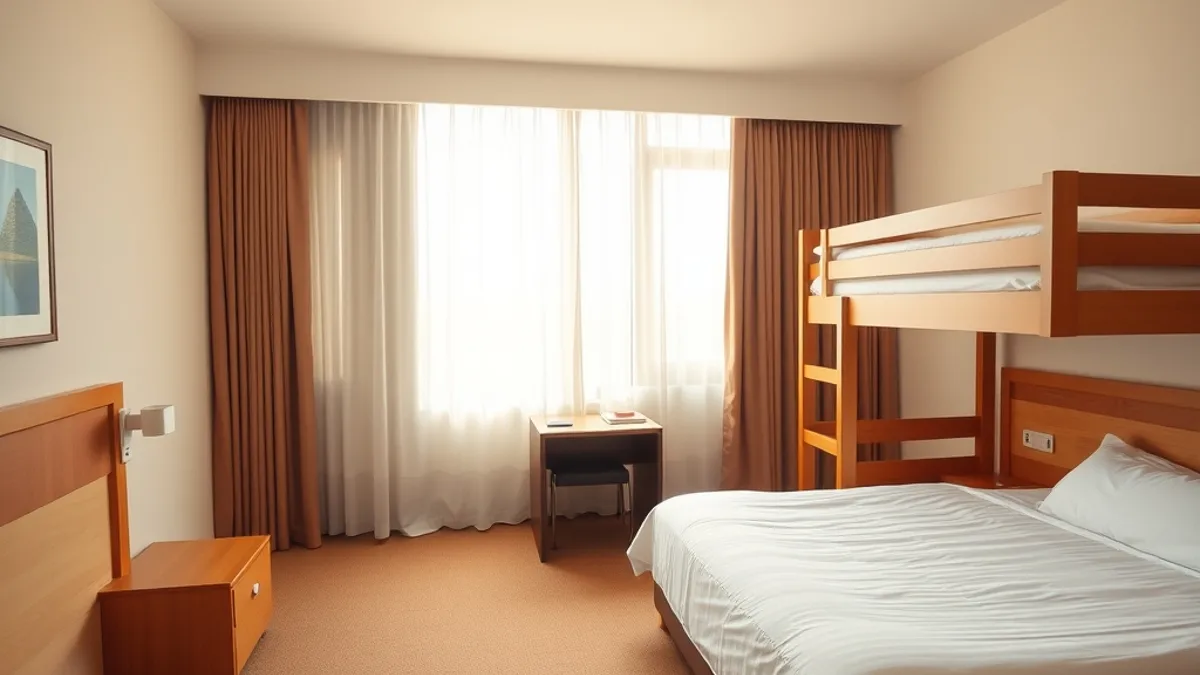
A family room is a single open space designed for one household. Instead of two separate rooms, you get one larger room where everyone sleeps under the same roof line. The most common layout gives parents a proper sleeping area, often with a king or queen bed, while children get bunk beds, a sofa bed or a pull-out in the same space. Some family rooms add a partial divider or a small alcove, but there is no door between sleeping areas.
Space and price
Family rooms commonly sleep 4 to 6 guests, which covers most families with one to three children. The price is the main draw: they usually add 20 to 40 percent to the cost of a standard room, making them far cheaper than booking two full rooms. For families on a tighter budget, that difference alone can decide the trip.
The one-bathroom reality
Here is the detail that catches parents off guard: nearly all family rooms come with one bathroom for the whole family. With two adults and a few kids getting ready for dinner or a morning excursion, that single bathroom becomes a bottleneck fast. If your children are old enough to take long showers or need help in the bathroom, think carefully about whether one bathroom will work. It sounds like a small thing until you are queuing outside it at 7 a.m. on day three of your vacation.
Interconnecting Rooms vs Family Rooms: Privacy and Supervision
This is where the two setups differ most, and where the right answer depends entirely on your children’s ages. With interconnecting rooms, the physical separation changes the evening dynamic completely. Teens can stay up later reading, watching TV or playing on their phones in their own room while parents sleep in the next room behind a closed door. Nobody has to whisper in the dark or lie awake listening to someone else’s show.
Life in a family room
A family room means everyone shares one space, so early bedtimes apply to adults too. If your six-year-old goes to bed at 8 p.m., that is when the lights go down for you as well. Some parents don’t mind this at all, especially on trips where everyone is exhausted by evening. Others find that a week of silent reading by phone flashlight gets old quickly.
Supervision without sharing
Connecting doors hit a sweet spot for parents of young teens. The kids get a sense of independence in their own room, but you can check on them in seconds and hear them through the wall. Connecting doors usually have double-soundproofed cores, so noise transfer is lower than you might expect, though it is still higher than between fully separate rooms. You get supervision when you want it and privacy when you don’t, which no single-room layout can offer.
Price and Availability Trade-offs
Price is where these two options really diverge. A family room usually costs a bit more than a standard room, but a pair of interconnecting rooms counts as two full bookings, which pushes the total far higher. If you are watching every dollar, the family room looks like the obvious winner.
The catch is availability. At family-oriented resorts, family rooms are the first category to sell out in peak season, precisely because everyone else is doing the same math. Interconnecting rooms are even tighter: they often make up only 5 to 10 percent of a hotel’s total inventory, so the pool is small from the start. For summer travel, book 3 to 6 months ahead if a connecting setup is non-negotiable for you.
Before you commit, get the connecting door confirmed in writing. Some hotels treat it as a request only, which means you could arrive with two booked rooms that do not actually connect.
- Ask whether the connecting door is guaranteed at booking or simply noted as a preference on your reservation, since the difference can determine your entire room setup.
- Check whether the two rooms are sold as a single package or as separate reservations, because separate bookings can be released or moved independently if the hotel is busy.
- Look at whether the connecting pair is in the same room category you want, since some hotels only offer connecting doors between specific room types or floors.
- Consider travel dates outside school holidays, when both family rooms and connecting pairs are easier to secure and often priced lower.
How to Choose Based on Your Children’s Ages
Your children’s ages should drive this decision more than anything else. Children under 8 do best in a family room, where parents are always present and you can hear every cough and nightmare without getting out of bed. At this age, being in a separate room overnight is more stressful for everyone than sharing space. It also means no midnight walks down a hallway to check on a crying toddler.
Kids aged 8 to 14 benefit from interconnecting rooms. They get the independence of their own space, and you get the peace of mind of a connecting door you can open at any time. This is the sweet spot where the extra cost of two rooms starts to pay real dividends, because everyone sleeps better when nobody is tiptoeing around a sleeping sibling.
Families with three or more children often have no choice in the matter. Most family rooms top out at around six guests, so a family of five or six with two adults may simply not fit, especially once you count the beds rather than the people. A pair of interconnecting rooms sleeping 4 to 8 becomes the practical answer, and sometimes the only configuration the hotel can actually offer you.
- For under-8s, check whether the family room’s children’s beds are within arm’s reach of the parents’ bed, which makes nighttime wake-ups far easier to handle.
- For the 8 to 14 group, ask whether the second room in a connecting pair has its own television and seating, since that is what makes kids feel they have a space of their own.
- For three or more children, count total sleeping capacity carefully, including whether sofa beds or rollaway beds count toward the hotel’s official occupancy limit.
- Consider mixed-age families, where a family room for the youngest plus a connecting pair for older siblings may be worth asking the hotel about directly.
Questions to Ask Before You Book
A few pointed questions before you pay can save you from a room setup that does not match what you pictured. Hotels vary widely in how they describe family configurations, and the photos on a booking site rarely show the whole layout. Front desk staff and reservations teams deal with these questions all the time, so do not hesitate to be specific about your children’s ages, how many beds you need and what your morning routine looks like. Ask these questions directly with the hotel rather than relying on the booking platform’s descriptions, since third-party listings often use vague or inconsistent terminology.
- Ask whether the connecting door can be confirmed at the time of booking or only as a request closer to arrival, and whether there is a fee to lock it in. Some hotels only guarantee connecting rooms on request, so getting it in writing matters.
- Ask how many bathrooms the setup includes, and whether there is a bathtub for young kids. A family room with one bathroom and a walk-in shower only can make bath time and morning routines harder than expected, especially with more than one child.
- Ask whether the family room layout puts children’s beds in the same space as the parents’ bed, or in a separate alcove or partitioned area. This affects both privacy and how much sleep the adults actually get, since kids who fall asleep early may be disturbed by parents watching TV or talking.
Get the answers in writing, ideally in an email that you can reference at check-in. Hotels handle these requests differently, and a clear record of what was promised gives you something to fall back on if the room you are assigned does not match the conversation. If the front desk cannot resolve an issue on arrival, having that email on hand makes it much easier to escalate politely to a manager and get the setup you actually paid for.
The Right Fit for Your Trip
So which setup works for you? Interconnecting rooms win on privacy, bathrooms and flexibility for older kids and teens, but they typically cost 1.5 to 2 times a standard room rate. Family rooms win on price and simplicity, usually adding just 20 to 40 percent to a standard rate, and they suit families with young children who want everyone within arm’s reach.
In the end, the deciding factors are your children’s ages, your budget and how far ahead you can book. Match the room style to how your family actually travels, and you’ll avoid the awkward compromises that come from choosing on price alone. If this helped you decide, share the article or leave a comment with your own experience.