You booked a lodge for the mountain views, the morning mist over the water, and long evenings on a deck watching the light fade. Then you check the forecast and see rain, possibly for days. It’s a sinking feeling, and it’s one almost every lodge traveler has faced. But a rainy day at a lodge doesn’t have to mean a ruined trip. With the right mindset and a little preparation, those gray hours can become some of the most relaxing and memorable parts of your stay.
This guide walks you through exactly how to make that happen. We’ll look at why rainy days can be the best part of a lodge stay, then cover indoor activities to enjoy at a lodge, from fireplaces and reading nooks to spa sessions. You’ll also find rainy day activities beyond the lodge, tips on how to plan ahead for bad weather, advice on choosing a lodge that handles rain well, and a sample rainy day itinerary you can adapt for your own getaway.
Why Rainy Days Can Be the Best Part of a Lodge Stay
Here’s a thought that surprises most first-time lodge guests: a rainy day often ends up as the highlight of the trip. That’s not luck — it’s design. Good lodges are built around the idea that you’ll want to stay in. Fireplaces, reading nooks, shared lounges and oversized windows facing the water or forest exist precisely so that bad weather becomes part of the experience rather than an interruption.
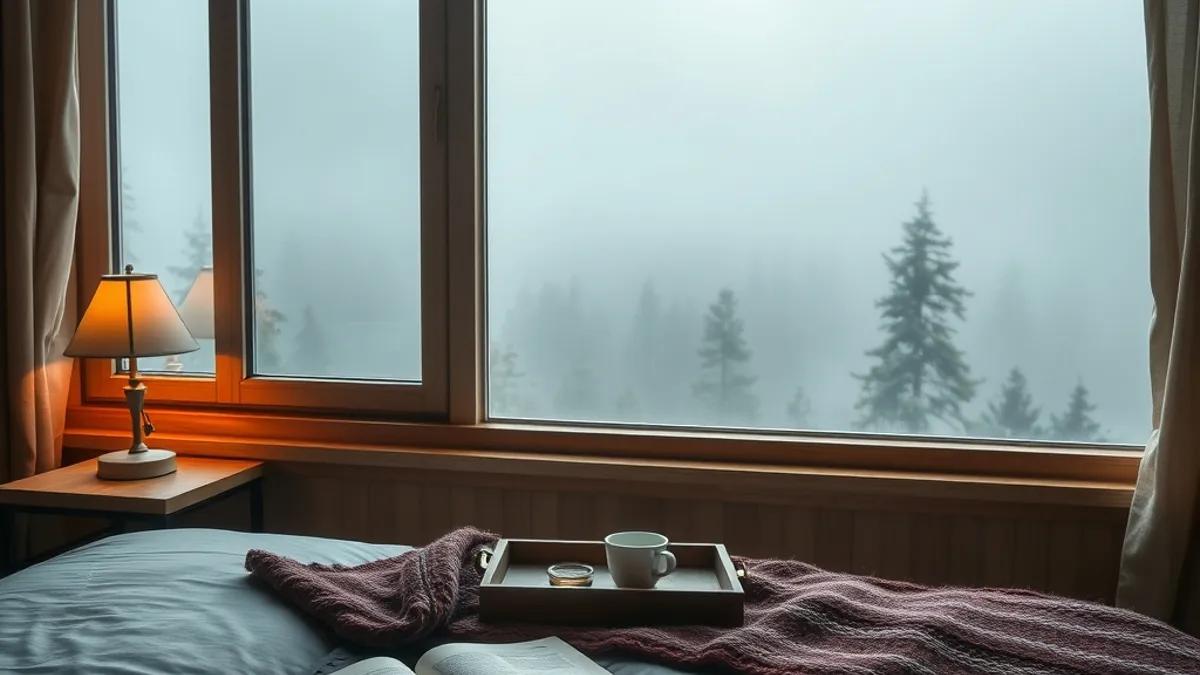
Rain also transforms the landscape in ways sunshine can’t. Mist drifts across lakes and through the trees. Rain drums softly on the roof and porch, which is its own kind of soundtrack. Trails and common areas empty out, so you get quieter hikes between showers and more of the lounge to yourself. If you’ve ever watched fog roll over a mountain lake from a dry, covered porch with coffee in hand, you know exactly what I mean.
Reframe the day instead of fighting it
The mindset shift that helps most: plan one outdoor anchor per day — a short walk, a drive to an overlook, a visit to a nearby town — and let the rest of the day fill itself. If the anchor happens in a dry window, great. If it doesn’t, the fireplace and the bookshelf are waiting, and you’ve lost nothing. Travelers who treat rain as a schedule-killer tend to have the worst trips; travelers who treat it as atmosphere tend to remember those days longest.
Indoor Activities to Enjoy at a Lodge
When the rain settles in for the day, the fireplace lounge becomes the heart of any good lodge. Most lodges keep a stack of well-worn books near the fire, and it is common to see guests swapping novels with strangers by mid-afternoon. If you finish your book, leave it on the shelf and take someone else’s — it is a small tradition that costs nothing and often starts a conversation.
Ask the staff what they would read, too. Front desk teams and guides usually know the local nature writers, regional history titles or trail maps worth browsing, and their picks are far more interesting than anything you would grab at an airport. Some lodges even keep a small guest library with a sign-out system.
The quiet hours between lunch and dinner are also perfect for slower pursuits. A deck of cards or a jigsaw puzzle on a low table by the window can absorb an entire afternoon, especially with coffee and rain sound in the background. If you prefer something more restorative, this is the window when spa appointments are easiest to get — many lodges offer massage sessions that run 60-90 minutes, and there is something uniquely satisfying about a sauna or hot tub while rain streaks the windows.
Evenings often bring organized fun. Many lodges run fireside happy hours, wine or whiskey tastings, or casual cooking demonstrations during wet weather, and these tend to fill up. Ask at the front desk the night before so you can plan your day around it rather than showing up to a full room.
Finally, do not underestimate the simple stuff. A covered porch with a chair and a view of mist moving through the trees is one of the best photo spots you will find on a rainy day, and soft gray light is surprisingly flattering. A short journaling session or a slow planning conversation over breakfast coffee — plotting tomorrow’s hike with a map spread across the table — turns a washout day into the one you actually remember.
- Bring a “leave one, take one” paperback from home so you can join the lodge book swap without emptying their shelf, and tuck a few sticky notes in it for the next reader.
- Pack a compact game with broad appeal — a standard deck or a small party game in the typical $10-30 range covers everything from solitaire at breakfast to a four-player tournament after dinner.
- Book spa treatments for the rainiest forecast slot, not the sunny one; a massage while a storm rolls past the window beats the same treatment on a day you would rather be on the trail.
- Ask staff what is scheduled each evening — tastings and happy hours are often informal and announced only a day ahead, so a quick question at check-in keeps you in the loop.
- Shoot from under cover, not from the trail: porches and verandas give you rain streaks, mist layers and dripping eaves as foreground elements, which are hard to capture once you are outside.
- Use the rainy morning to finalize tomorrow’s route — check trail conditions with staff, mark your map, and pack your day bag so a clear-sky morning does not get lost in logistics.
Rainy Day Activities Beyond the Lodge
When the rain settles in for the day, the area around your lodge often has more to offer than you’d expect. Start by asking the front desk or concierge what’s within a 30-60 minute drive. Staff at mountain and lakeside lodges usually know the local museums, visitor centers and covered attractions that make sense in wet weather — think regional history museums, national park visitor centers with exhibits, aquariums or covered markets. They can also tell you which roads stay comfortable in the rain.
Scenic drives and town outings that work in wet weather
Not every outdoor experience requires a trailhead. Scenic drives often shine on rainy days: lake overlooks take on a moody, misty quality, and waterfalls can be even more impressive after fresh rainfall. Pick a route with pull-offs so you can step out briefly without committing to a hike, and check with staff or a ranger about road conditions before you set out.
A nearby village or small town makes an easy half-day outing. Wander into a café for a long lunch, browse a bookshop, and stop at local craft stores or galleries for gifts you won’t find at home. It’s a relaxed way to see the region without worrying about the sky.
If you’d rather stay on foot, short wet-weather hikes are entirely doable with the right gear. A packable rain jacket and pants set weighs under 1 kg, and it keeps a 1-2 hour walk genuinely comfortable rather than a soggy ordeal. Choose well-maintained trails near the lodge, wear quick-drying shoes, and save longer routes for a clearer day.
How to Plan Ahead for Bad Weather
Bad weather is not a surprise you have to suffer through — it is something you can plan around with a couple of emails and a smart packing list. The trick is to prepare in stages: first the forecast, then the lodge itself, and finally your bag. Do it in that order and a rainy stretch becomes a scheduled part of the trip rather than a disruption. Think of it like booking a dinner reservation: you would not show up and hope for a table, so do not show up at a lodge and hope the rain sorts itself out. A little structure up front means you spend your wet afternoons relaxing instead of improvising, and the steps below take less effort than most people expect.
- Check the forecast 3-5 days before travel. Weather apps are most reliable 3-5 days out, not weeks ahead, so that is the moment to look at rain probabilities and decide whether to shift a long hike to a different day. If rain shows up on the radar, build one flexible day into a 4-5 night stay — a day with no bookings, no deadlines and no commitments.
- Ask about indoor amenities when you book, ideally 2-4 weeks before arrival. Send the lodge a short email: does the library have a book swap, is there a shelf of board games, do the spa and sauna take reservations, and is there a covered terrace where you can sit outside in the rain? If you will not have a car, also ask about shuttle service to nearby towns or attractions.
- Prioritize common spaces if you travel in the wet season. At many mountain and coastal lodges, the rainiest months run from November to March. If your dates fall in that window, the lounge, fireplace and library will matter more than the pool or the trail map, so weigh them heavily when choosing where to stay.
- Pack a small weather kit. A full set of rain jacket and pants weighs under 1 kg and turns a downpour from a problem into a non-event. Add quick-dry shoes, a couple of dry bags for phones and cameras, and a deck of cards. The whole kit fits in a single packing cube.
None of this takes more than an hour of preparation, spread across the weeks before you leave. A forecast check, one email to the lodge and a single packing cube are the entire workload. The payoff is a trip where the weather changes your plans by choice, not by accident — and where a rainy afternoon feels like something you booked on purpose. Even better, the flexibility you build in for rain often pays off in sunshine too: an unplanned morning suddenly becomes room for a spontaneous extra hike, a slow breakfast or a scenic detour you would otherwise have rushed past.
Choosing a Lodge That Handles Rain Well
Not all lodges are equally enjoyable when the sky opens up. Some are essentially a bedroom with a trailhead attached — fine in sunshine, grim in a downpour. Others are designed around lingering, with fireplaces, deep armchairs and windows that frame the weather like a painting. The difference is easy to spot before you book, if you know what to look for.
Start with guest reviews and read them with rain in mind. If multiple guests mention the fireplace, the library, the lounge or the spa, that is a strong signal the property works indoors. Reviews that only praise the views and the hiking should make you cautious for a wet-season trip. Covered outdoor spaces are the second thing to check: a veranda or covered porch lets you sit out with coffee while rain streams off the roof, which is a very different experience from being trapped inside.
- On-site dining is a bigger deal than it looks. In a serious downpour, you will not want to drive 30 minutes to the nearest restaurant, so a lodge with a good kitchen and a fireside dining room keeps your evening simple and warm.
- Location shapes the rain scenery. Lodges set near lakes and forests — think Crater Lake or the rainforested corners of Olympic National Park — put on a dramatic show when mist rolls over the water and drips from the trees.
- Ask about spa and wellness facilities directly. A sauna or treatment room turns the wettest afternoon into the most relaxing one, so confirm what actually exists on site rather than assuming.
For a concrete example of a lodge that rewards bad weather, it is hard to beat the setting described in this Crater Lake lodge review, where storms over the lake become part of the appeal rather than an obstacle to it.
Sample Rainy Day Itinerary at a Lodge
The best rainy lodge days share a simple rhythm: something restorative in the morning, something slow in the afternoon and something warm in the evening. You do not need a strict schedule — think of this as a template you can stretch or shrink depending on how long the rain lasts. The only real rule is to sync your indoor time with the weather, saving the outdoors for the gaps between showers.
Mornings tend to bring the heaviest rain in most mountain and coastal regions, which makes them perfect for the spa. Book a 60-90 minute massage or sauna session for late morning, when the rain is usually at its peak and you would not want to be outside anyway. Let breakfast run long first — there is no reason to rush when the day has nowhere to go.
- Afternoon by the fire. Set up in the lounge with a board game — most lodges keep a shelf of them, and a deck or game typically costs $10-30 if you want to bring your own — then break for a short photo session from the covered porch when the light turns moody.
- Dinner without leaving the building. Book a table at the lodge restaurant, ideally early enough to get a seat near the fireplace, and let dinner stretch well past dessert with coffee or a nightcap.
- Stargazing between showers. Rain often arrives in bands rather than lasting all night, so step outside during a break — if the sky clears, wet air can make the stars and the silhouettes of the trees unusually sharp.
By the time you turn in, the day will have felt full without feeling busy. That is the quiet advantage of a lodge in the rain: it rewards exactly the kind of unhurried pace that most trips never allow.
Wrapping Up Your Rainy Lodge Getaway
So, is a rainy lodge trip ruined before it starts? Not even close. Rain does not cancel a lodge stay — it changes its rhythm. Fireplaces, board games, spa time and misty scenery often end up as the moments you remember most, not the hikes you skipped. Many travelers come home saying the wet, cozy days were the highlight of the whole trip.
The difference between a soggy disappointment and a great getaway comes down to a little planning. Check the forecast 3-5 days before you travel, confirm indoor amenities 2-4 weeks ahead, pack light rain gear and one flexible day, and let the lodge handle the rest. Do that, and the weather becomes part of the experience instead of a problem. Have a rainy lodge story of your own? Leave a comment or share this article.