You have just checked into a resort, and within ten minutes a small crowd of staff has helped you: someone carried your bags, someone parked your car, and someone else handed you a welcome drink. Now you are standing in your room wondering who expects a tip, how much is right, and whether a service charge on your bill already covers everyone. If that sounds familiar, you are not alone. Resort tipping etiquette is genuinely tricky, and the rules are different from what you might know from regular hotels.
This guide breaks down exactly who to tip and how much, from bell staff and housekeeping to spa therapists and poolside servers. We will also cover restaurant and room service gratuities, how to handle all-inclusive properties, and what changes when you travel abroad. By the end, you will know the standard amounts, the right timing, and a few simple habits that make tipping feel natural instead of stressful.
Why Resort Tipping Feels So Confusing
The first reason resort tipping feels overwhelming is simple math. A standard hotel might have a handful of people you could tip: a bellhop, a housekeeper, maybe a valet. A resort, on the other hand, employs far more specialized staff. There are pool attendants, beach servers, spa therapists, activity instructors, dive guides, concierges, and often an entire second set of restaurant teams. Each interaction is a small decision about whether and how much to tip, and the number of decisions adds up quickly.
Service charges are not always what they seem
Many resorts add a service charge or gratuity to your bill, which makes it tempting to assume everyone is already taken care of. The catch is that these charges do not always reach the individual staff member who served you. In some cases they are pooled or distributed in ways that leave the person handing you your drink or refreshing your towels with very little. That is why a cash tip still matters, even at properties that advertise gratuities as included.
The second complication is geography. Tipping norms shift by country and by resort type, so a single fixed rule does not work. What feels generous in the Caribbean can seem excessive in parts of Europe or Asia, and an all-inclusive property operates by different conventions than a city hotel. The sections below give you practical ranges for each situation, so you can adjust for where you are and who is helping you.
Arrival and Departure: Bell Staff, Valet and Front Desk
Arrival and departure set the tone for your whole stay, and they involve the staff you meet face to face most often. Bell staff are the easiest starting point. When they collect your bags at check-in, a tip of $1-2 per bag is standard. If they haul heavy or multiple bags up to your room, especially to a villa or an upper floor, $5-10 is a fair amount for the extra effort. The same applies at checkout if they bring luggage down and load it into a taxi or your car.
Valet service is another spot where timing matters. Rather than tipping only at the end of your stay, give $2-5 each time your car is returned. If you come and go several times a day, this adds up, but the person retrieving your vehicle is often not the same one from earlier, and each trip is its own service.
Who gets what at the front of house
- Front desk agents: They typically do not expect tips, but $5-20 is appropriate if they secure an upgrade, a late checkout, or a special arrangement like a surprise anniversary setup.
- Bell staff at checkout: If they store your bags after checkout and bring them back when your transfer arrives, that extra handling deserves a small additional tip beyond the per-bag standard.
- Door attendants: The staff who hail taxis or load your luggage into vehicles appreciate a dollar or two, especially when they go beyond simply opening the door.
One habit makes all of this easier: hand tips in cash directly to the person who helped you rather than leaving them at the desk. Money left on a counter can be swept into a general fund or simply lost, and a direct handoff also lets you say thank you in person.
Housekeeping: Daily Rates and the Right Timing
Housekeeping is the role travelers most often forget to tip, and yet it involves the most repeated service of your stay. Someone is making your bed, replacing towels, and tidying your room every single day of your vacation. That consistency is exactly why housekeeping deserves a spot on your tipping list, right alongside the bartender who remembers your drink order. If you are staying a week, a modest daily amount adds up to a meaningful contribution for the person doing the work.
Why daily beats a lump sum at checkout
It is tempting to leave one larger tip on your last morning, but tip daily rather than in one lump at checkout. Resorts often rotate housekeeping assignments, which means different staff may clean your room on different days. A single tip at the end rewards only whoever happens to be on duty that morning, while daily tipping reaches everyone who actually served you.
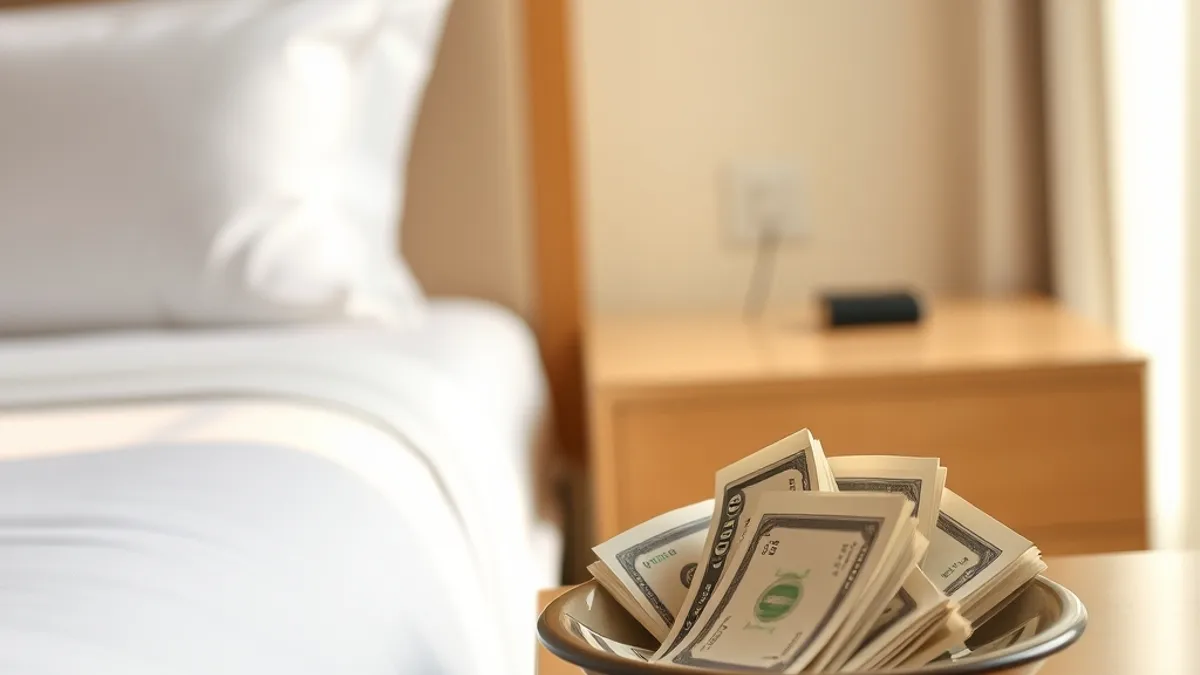
Placement matters too. Leave cash on the pillow or in a marked envelope so it is clearly meant for housekeeping. Money left on the nightstand or desk can look like forgotten pocket change, and staff may hesitate to take it. A simple note saying “thank you” removes any doubt about who the money is for.
Finally, increase the amount if you request extra services. Additional towels, extra pillows, a late refresh before dinner, or a particularly messy room after a day with the kids all mean more work for the housekeeping team. A few extra dollars acknowledges that effort and keeps the relationship friendly for the rest of your stay.
Restaurants, Bars and Room Service
Resort restaurants and bars follow the same basic rule you know from home: tip waitstaff and bartenders 15-20% of the bill. The difference is that resort dining often involves more moving parts. A waiter may bring your drinks, your food and your dessert, while a separate runner delivers the bread and a busser clears the table. In practice, the 15-20% you leave covers the whole team, so there is no need to tip each person separately unless someone goes well beyond the usual service.
Before you calculate anything, look carefully at the bill. Some resorts roll an automatic gratuity into dinner checks and large group meals, and this line item does not always make it into the pocket of the person who served you. That does not mean you should tip twice on every meal, but you should know what is already on the check before deciding how much cash to leave. If a gratuity is already included and service was genuinely good, a small extra amount for your server is a friendly gesture; if nothing is added, tip the full 15-20%.
Room service is its own small category. A delivery usually warrants a few dollars in cash handed to the person at your door. If no delivery charge or service fee appears on the bill, treat it like a restaurant order and tip the standard percentage instead.
- Charging drinks to your room does not delay the tip. Poolside and beach bar service deserves the same 15-20%, so either hand cash to the server on the spot or add a tip line when you sign the check.
- Sign-and-tip works at the bar too. If you open a tab at a swim-up bar, you can add the gratuity when you close it out, though handing a few dollars to the bartender per round keeps the service attentive.
- Split meals still need one full tip. When a couple orders separately but pays together, calculate 15-20% on the combined total rather than tipping twice on two small checks.
Spa, Pool, Beach and Activity Staff
The wellness and activity teams at a resort often work the hardest for the least recognition, yet many travelers skip them entirely because they are unsure of the etiquette. Spa therapists should be tipped 15-20% of the treatment price, and cash is preferred where possible. Some spas add a service charge to the bill or leave a tip envelope at reception, so ask at check-in how gratuities are handled before assuming your therapist will receive anything.
If the resort automatically adds a gratuity, you can still hand your therapist something extra when the treatment felt personal and skilled. A brief thank-you with cash as you leave the treatment room is the clearest way to show appreciation, and it guarantees the money reaches the person who earned it rather than disappearing into a pool.
Pool and beach attendants earn their keep in small moments: dragging two loungers into the shade, setting up an umbrella before you arrive, or fetching fresh towels twice a day. A tip of $2-5 each time they set up your chairs or bring towels is a fair way to acknowledge that work. You do not need to tip for a simple towel pickup, but regular setup help deserves regular thanks.
Activity and watersports instructors are a different case, because the tip should reflect the session itself. Plan on $5-20 depending on how long the session lasted and how much personal attention you received. A short group stretch class sits at the low end, while a private snorkeling or sailing lesson with one instructor belongs at the top of that range.
- Book the tip at the spa desk or give it directly. If you charge the treatment to your room, ask whether you can add a gratuity line; if not, bring cash to hand to the therapist as you leave the treatment room.
- Tip after the activity, not before. Handing an instructor $5-20 at the end of the session, once you know how much guidance you actually got, keeps the incentive honest and the amount fair.
- Match the concierge tip to the difficulty of the request. A concierge who books hard-to-get reservations deserves $5-20 for simple requests, while someone who builds a full itinerary of tours and tables is better thanked with 10-15% of what their work saved you in hassle.
All-Inclusive Resorts and Tipping Abroad
All-inclusive resorts create the most confusion of all, because the marketing suggests everything is covered. In reality, even when tips are officially included in your package, the money rarely flows to the specific staff who serve you. A practical approach is to budget around $10-20 per day in cash for the people who actually hand you drinks, clean your room and wait on you at dinner. Spread across a week, that is a modest addition to your trip that makes a visible difference to the staff who earn it.
Abroad, the rules bend again. In Europe and much of Asia, tipping is modest or optional, and a few euros or the local equivalent is genuinely enough. At a European resort, a small thank-you for standout service often goes further than a large automatic percentage would. For a look at how a European resort handles service culture, this review of a resort and Thai spa in Benidorm, Spain shows what attentive service looks like when gratuities are not the driver behind it.
Where small tips matter most
In destinations like Mexico and the Caribbean, small tips in local currency are warmly received even at inclusive resorts. Staff there often depend on gratuities as a meaningful part of their income, so a few pesos or dollars handed directly to a bartender or housekeeper is noticed and appreciated. That is quite different from a formal European property, where a tip can sometimes feel unnecessary rather than generous.
Practical money habits
Cash in small bills is preferred almost everywhere, especially when traveling abroad. A bartender handed a single large denomination note may have no change to give back, which turns your generous gesture into an awkward moment. Stop at an ATM or exchange counter early in your trip and stock up on small denominations, then keep a modest stash in your room or day bag so tipping stays simple every single day of your stay.
Tipping With Confidence at Any Resort
So, back to that first moment of confusion: a bellhop has just dropped your bags, someone else parked your car, and a dozen other staff members are drifting through your stay. The truth is that tipping at a resort is not one rule but a handful of simple figures, and once you know them, the whole thing becomes second nature. The core numbers to remember are 15-20% for dining and spa services, $2-5 per night for housekeeping, and $1-2 per bag for bell staff.
Cash in small bills is the safest approach in every setting, passed hand to hand whenever you can and given daily where it makes sense. Adjust for the country and the resort type, and if you are staying at an all-inclusive property, budgeting $10-20 per day in tips covers everyone who serves you well. If this guide helped you sort it out, leave a comment or share it with a fellow traveler.