Many travelers assume rustic lodges simply cannot accommodate wheelchairs, so they rule out lodge stays altogether without ever asking what a property actually offers. That is a costly assumption. While some older lodges genuinely are inaccessible, plenty of others have step-free entrances, roll-in showers and rooms designed for side transfers. The real challenge is that wheelchair-friendly lodges rarely advertise their features clearly, so the travelers who give up early are often the ones who never learned what to look for.
This guide walks you through the whole process: why accessible lodge rooms are so scarce, which features separate a genuinely wheelchair-friendly room from one with just an “accessible” badge, how to search and filter effectively, the questions to ask before you book, timing strategies that improve your odds, destinations where accessible lodges are more common, and a final checklist to confirm everything before you pay.
Why Wheelchair-Friendly Lodges Are Harder to Find
Lodges occupy a tricky middle ground between hotels and cabins. Many are older buildings, built decades before accessibility standards existed, and remote locations make construction work slower and more expensive. Retrofitting a timber-framed lodge with a ramp, widened doorways or a roll-in shower is possible, but owners often prioritize other upgrades, which is why these features remain rare in the lodge category.
A tiny slice of the room inventory
Even when a lodge does offer accessible rooms, they are usually a very small share of the property. Across the industry, wheelchair-friendly rooms often make up just 1-5% of total rooms. A 40-room lodge might have one or two, and once they are booked, there is no alternative on site. This scarcity is why accessible rooms tend to sell out before everything else.
Why the “accessible” badge misleads
Listing sites add another layer of confusion. Filters and badges flag properties as accessible inconsistently, and a badge rarely tells you what is actually provided. One lodge may use the label for a room with a grab bar only, while another reserves it for a full step-free suite with a roll-in shower. Treat every badge as a starting point for a conversation, never as confirmation.
What Makes a Lodge Genuinely Wheelchair-Friendly
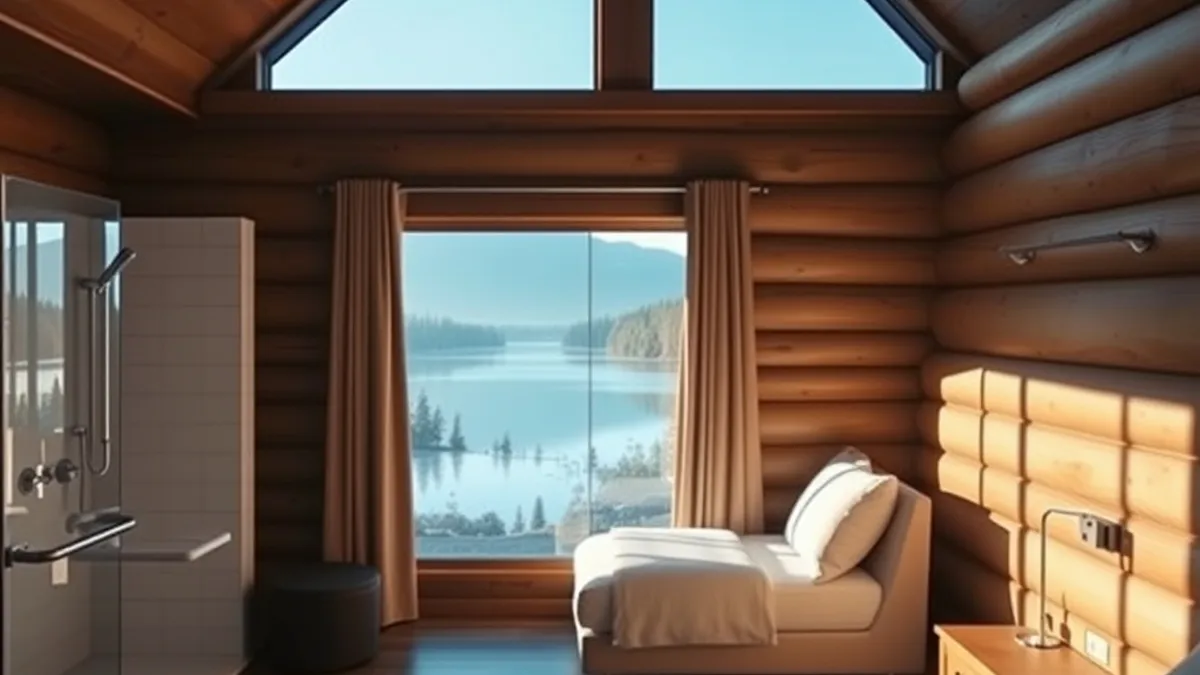
A room labeled accessible is not the same as a room that works for a wheelchair user. The difference comes down to specific, measurable features, and knowing them helps you ask precise questions instead of accepting vague answers. Start with the essentials: a step-free entrance and doorways at least 32 inches (81 cm) wide, which is the minimum for comfortable wheelchair passage. In the bathroom, a roll-in shower is far more practical than a bathtub with grab bars, and it should include grab bars and a fold-down bench so you can shower seated or standing.
Bed height matters just as much. A bed that is too high or too low makes a side transfer difficult or unsafe, and 60-inch (150 cm) turning circles in both the room and bathroom determine whether you can actually move around once inside. Step-free paths from parking to reception, the restaurant and key outdoor areas complete the picture, because a perfect room loses its value if you cannot reach dinner.
- Lowered sink and mirror: a sink and mirror at standard height force you to approach sideways at an awkward angle; lowered versions let you wash and groom facing forward.
- Shower controls within reach: controls placed at the entry end of the roll-in shower let you adjust water temperature before rolling in, rather than getting wet while testing.
- Light switches and outlets at reachable heights: switches too high or outlets too low turn simple tasks into struggles, especially for independent travelers.
- Step-free terrace and fire pit access: many lodge highlights like fire pits and viewing decks sit on raised platforms; confirm at least one is reachable without steps.
How to Search and Filter for Accessible Lodge Stays
Booking filters are a useful starting point, but they should never be your final answer. On major booking platforms, filter for accessible rooms and step-free access, then go straight to the property’s own website and look for its accessibility page. That page usually lists exact features, such as door widths and shower types, that the booking site’s badge never explains. If the lodge has no accessibility page, that itself is useful information about how seriously it takes accessible travel.
Where the best descriptions live
National park lodges in the US often publish the most standardised accessibility information in the lodge world. Because they operate within a system that documents room features, you can frequently find detailed descriptions of door widths, bathroom layouts and step-free paths before you ever pick up the phone. Reading a detailed write-up like a review of Signal Mountain Lodge can give you a feel for how these properties describe their rooms and what to look for in similar lodges.
Let recent guests fill the gaps
Guest reviews are your reality check. Look for recent reviews that mention mobility needs, wheelchairs or roll-in showers specifically, because these reveal real conditions on the ground: whether the “accessible” room had a step at the terrace, whether the roll-in shower worked as described, or whether the path from parking was actually step-free. A review from last season tells you more about today’s conditions than any marketing copy, and it can highlight details the lodge itself never thought to mention. Combine what you learn from filters, official pages and reviews before you commit to a booking.
Questions to Ask Before You Book
A “yes, we’re accessible” over the phone tells you almost nothing. Two lodges can both claim an accessible room while one has a roll-in shower and the other a bathtub you cannot use. Roll-in showers are far more common in accessible rooms than bathtubs with grab bars, but you will not know which one you are getting unless you ask directly. The difference between a smooth stay and a canceled trip usually comes down to how specifically you ask.
- Ask for exact measurements, not yes-or-no answers. Request the doorway width in inches or centimeters, the bed height from the floor, and whether the shower is a true roll-in with a fold-down bench and grab bars. A vague “the doors are wide” is not an answer; a number is.
- Get it in writing. After your call, send an email asking the lodge to confirm the specific features of the exact room you will be assigned, and ask them to reply confirming each one. A written confirmation gives you something to reference at check-in if anything does not match.
- Ask about the spaces beyond the room. Find out how far the accessible parking is from the entrance, and whether the restaurant, terrace, and fire pit areas are reachable without steps. A perfect room with a stepped terrace can still limit your evening.
Lodge staff are often happy to help, but many simply have not been asked these questions before. Specific, polite questions tend to get specific answers. If the person who answers the phone sounds unsure, ask them to check with a manager or the maintenance team and call you back. A lodge that takes the time to verify details is usually one that will take your needs seriously once you arrive. Those written answers are what let you book with real confidence rather than hope, and they give you a clear basis for comparison if you are deciding between two properties.
Booking Strategy: Timing and Flexibility
Accessible lodge rooms are a small slice of inventory to begin with, so the usual advice about booking early applies double here. Because only a handful of rooms per property may work for a wheelchair user, they are often the first to go, especially at popular lodges during peak periods.
A practical target is to book 3-6 months ahead. That window gives you the best chance of securing one of the few accessible rooms before other travelers claim them, and it leaves you time to verify features and change plans if a phone call reveals the room will not actually work for you.
Try shoulder season
Traveling in shoulder season, the weeks just before or after peak season, improves your odds further. Demand for the small pool of accessible rooms drops, staff have more time to answer detailed questions, and you may even have a choice of more than one accessible room type.
Keep your cancellation options open
Even with careful research, details sometimes change or get miscommunicated. Choose lodges with flexible cancellation policies so that if a follow-up call reveals a missing grab bar or a stepped entrance, you can rebook elsewhere without losing your money. Flexibility is your safety net, and it is worth paying a little extra for when the room matters this much.
Destinations Where Wheelchair-Friendly Lodges Are More Common
Some destinations simply make your search easier. Where accessibility standards are well established and lodges are newer, you will find more genuinely wheelchair-friendly options and far less guesswork.
US national park lodges
Lodges in the US national parks often publish the most detailed and standardised accessibility descriptions you will find anywhere. Many list specific room features, path surfaces, and parking details on their official websites, which makes comparing options much simpler. They still sell out early, so combine this clarity with advance booking.
Newer lodges in Europe
Newer alpine and lakeside lodges in Europe more often include lifts, step-free ground-floor rooms, and modern bathrooms designed with mobility in mind. Older, historic properties in the same regions can be charming but full of steps and narrow doorways, so check the building’s age and renovation history before assuming anything.
Resort-style lodges with multiple buildings are another good bet. Because they offer many room types across several structures, they usually have more accessible rooms in total than a single historic building with a dozen keys. A large resort may have a roll-in shower room, a ground-floor room near the restaurant, and an accessible suite all at once, giving you options a small lodge cannot match. When in doubt, favor scale and newness over charm and character.
Your Accessible Lodge Checklist
If you’ve been skipping lodge stays because you assumed a rustic building couldn’t work for a wheelchair user, the good news is that genuinely accessible options do exist. The trick is knowing what to look for: verify the entrance, doorway and bathroom features in writing before you pay, because a website badge alone rarely tells the full story.
Remember that accessible rooms are a small share of any lodge’s inventory, so book that 3-6 month window early and aim for shoulder season when availability is better. Confirm that on-site paths and amenities are step-free, and you can travel with confidence rather than crossed fingers. If this guide helped you plan a trip, leave a comment or share it with a fellow traveler.