Here’s a frustrating scenario many travelers with mobility needs know well: you book a room labeled “accessible,” arrive tired after a long journey, and find a step at the door, a bathtub where you expected a shower, or a bathroom door too narrow to get through. The hotel wasn’t technically lying, but the room simply doesn’t work for you. This is why accessible hotel rooms deserve a closer look before you pay, not after you arrive.
The good news is that a handful of specific questions can filter out most unpleasant surprises. In this article, we’ll explain why the word “accessible” isn’t standardized around the world, which room dimensions and bathroom features to confirm, how to check entrances, elevators and routes, and why booking timing and written confirmation matter so much. We’ll also cover the staff support and equipment worth asking about, and finish with a checklist to run through before you confirm your reservation.
Why ‘Accessible’ Doesn’t Always Mean Accessible
The biggest trap with accessible hotel rooms is the word itself. There is no single global definition of “accessible,” and what it describes varies enormously from country to country. In parts of Europe, a hotel may advertise accessible rooms when the only accessible feature is an elevator. In the United States, the term often refers to rooms built to ADA guidelines, which cover doorway widths, bathroom layout and other specifics. Neither system is wrong, but they describe very different levels of access, and a booking site rarely tells you which standard a particular property is following.
Even within a single country, the label can be misleading. Plenty of hotels list rooms as accessible when they still have a threshold at the door, a doorway too narrow for a wheelchair, or a bathroom with only a tub and no roll-in shower. The room may suit someone who walks with a cane but be completely unusable for a wheelchair user, yet both travelers see the same word in the listing.
Why booking sites won’t save you
Third-party booking platforms rarely show room-level accessibility details. You might see a filter for “accessible rooms” and a few generic amenities, but not the doorway measurement, the shower type or the bed height. That information lives with the hotel itself, which means the only reliable way to verify a room will work for you is to contact the property directly, by phone or email, and ask specific questions before you book. The rest of this article covers exactly which questions to ask.
Questions About Room Layout and Dimensions
Once you’ve reached the hotel directly, the next step is to get concrete numbers rather than reassuring adjectives. “Spacious” and “wheelchair friendly” mean nothing without measurements. Start with the doorway: ask for the exact clear width in inches or centimeters, meaning the actual passable space once the door is open, not the frame size. For reference, ADA-standard doorways offer at least 32 inches (81 cm) of clear width, so anything narrower than that may be a problem for a wheelchair or walker.
Then move to the bathroom and the bed. A truly accessible bathroom usually means a roll-in shower, which typically measures 30 x 60 inches (76 x 152 cm), rather than a tub with high sides. Bed height matters just as much for anyone who transfers from a wheelchair: standard beds run 24-30 inches (61-76 cm) high, while a lower frame around 20-24 inches makes a safe, level transfer much easier. Some hotels can remove a bed frame or add a platform to lower the mattress, but only if you ask in advance.
Details worth adding to your question list
- Thresholds at the room and bathroom doors: even a small raised strip can stop a wheelchair, so ask whether the thresholds are flush, beveled or a few centimeters high.
- Space to turn: ask whether there is room to turn a wheelchair around inside the room and especially inside the bathroom, since a wide door leading into a cramped space doesn’t help much.
- Bed clearance underneath: ask how much open space is under the bed, because a frame that sits low to the floor blocks a hoist or makes certain transfers harder.
- Furniture placement: ask whether the desk, luggage rack or armchair can be moved, so you can create a clear path from the door to the bed and bathroom.
Finally, ask the hotel to send photos of the actual accessible room you would be booked into, not marketing images of a different room type. Properties often photograph their best suite and use it to represent every category, so request pictures of the doorway, bathroom and bed specifically.
Bathroom and Shower Details to Confirm
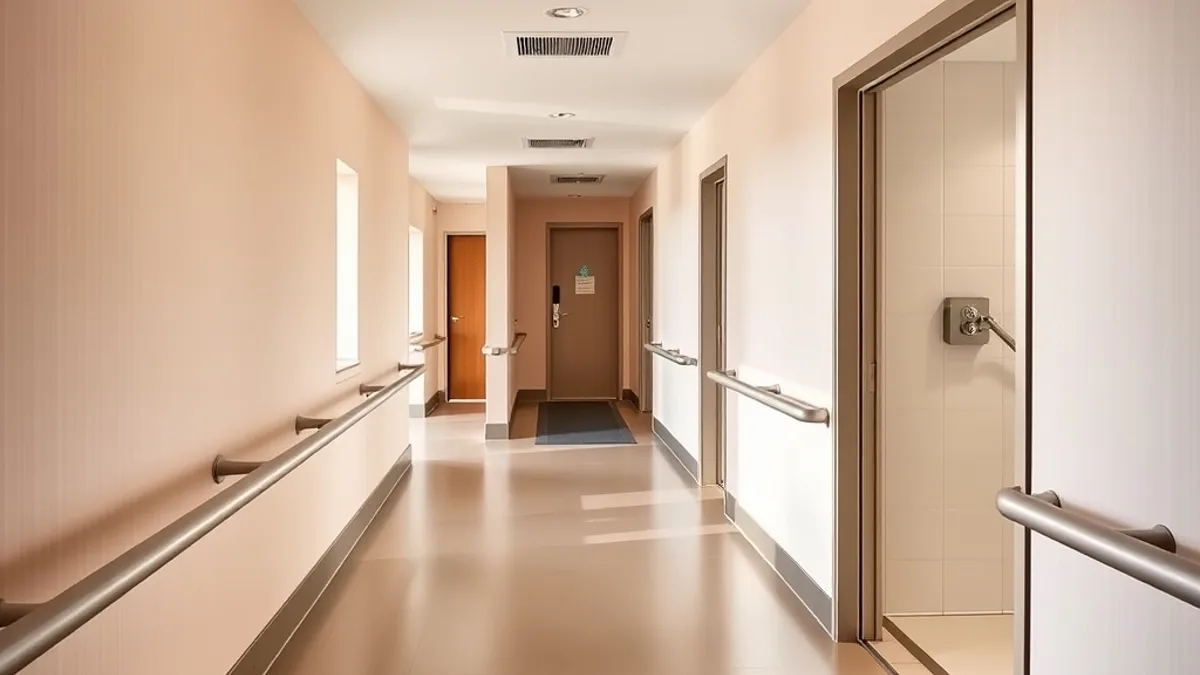
The bathroom is where accessible bookings most often go wrong, so this is the place to be thorough. Start with grab bars: confirm they are installed in the shower and beside the toilet, not just in one of the two. Typically they are mounted 33-36 inches (84-91 cm) above the floor, but the key question is whether they exist at all and where, since a bar on the wrong wall is of little use during a transfer.
Next, ask how the shower actually works. A handheld showerhead on an adjustable rail lets you shower seated at whatever height suits you, while a fixed head high on the wall may be out of reach. Seating matters too: a fold-down bench or a built-in seat turns a roll-in shower from a hazard into something usable. Ask which one the room has, and whether the floor is level at the entrance or has a lip.
More bathroom details to pin down
- Toilet height: ask for the seat height, since a very low toilet is difficult to get up from, and some hotels offer raised seats or a higher model on request.
- Clear floor space beside the toilet: confirm there is open room alongside it for a lateral transfer, because a toilet wedged between a wall and a vanity can be impossible to use.
- Sink and mirror height: ask whether the sink has open space underneath so a wheelchair user can roll up close, and whether the mirror is tilted or low enough to use seated.
- Non-slip flooring: ask whether the bathroom floor is textured or treated for grip, since wet tile is one of the most common causes of falls in hotel bathrooms.
Once you have answers to all of this, don’t rely on a friendly voice on the phone. Request written confirmation of these features by email, listing each one explicitly, and keep the reply. If something is missing at check-in, that email is your proof and your best leverage to get the situation fixed or the booking changed.
Getting There: Entrances, Elevators and Routes
A beautifully described accessible room is useless if you cannot physically get to it. The path from the street, parking lot or airport shuttle drop-off to your door matters just as much as the room itself, and it is often overlooked until arrival day. Make the journey part of your questions.
Start at the front of the property. Ask plainly whether the main entrance has steps or a ramp, and whether there is step-free access from both the parking area and the street side. Some hotels have a ramp at the back entrance only, which can mean a long detour with luggage or a wheelchair.
Next, work upward. An accessible room on the third floor of a building with a small, slow elevator is very different from one on the same floor as the lobby. Confirm your specific room is on a floor the elevator actually serves, not up a half-flight of stairs or on a split level that the elevator skips entirely.
Finally, think about the last few meters between the elevator doors and your room. This stretch trips up more travelers than the entrance does, so ask about the details below:
- Thresholds: Even a raised strip of a few centimeters at the room door or bathroom doorway can block a wheelchair or cause a stumble, so ask if doorways are flush or beveled.
- Carpet thickness: Deep or plush carpeting in corridors is harder to push a manual wheelchair across; low-pile carpet or hard flooring is much easier.
- Corridor width: Narrow hallways with sharp corners can make it impossible to turn a wheelchair around, so ask whether the route allows a full turn.
- Self-opening doors: Heavy fire doors along the route can be difficult without an automatic opener or a staff member nearby.
Older and heritage properties deserve special attention. Listed and historic buildings are often exempt from modern accessibility standards, so a charming centuries-old hotel may legally have steps, tight corridors and no elevator at all. Ask specifically about heritage-building limitations before you book, and get the answers in writing so there are no surprises at check-in.
Booking Timing and Getting It in Writing
Here is the frustrating truth about accessible rooms: they are scarce, and demand for them keeps growing. Many properties have only 1-5 accessible rooms in total, so a hotel can be fully “sold out” of them weeks before standard rooms fill up. That scarcity is exactly why the booking process matters so much. A rushed reservation made through a generic website often leaves you with a room category that sounds right but delivers something very different from what you need. For peak season travel, aim to book 2-3 months ahead rather than hoping something frees up closer to your dates.
- Call the hotel directly. Skip the central reservation line or booking platform. Front desk staff or a dedicated reservations team at the property has actually seen the rooms and can describe the shower, doorways and bed height from memory, while a call center usually reads from the same vague listing you already found.
- Ask specific questions about your exact room. Confirm the features you need, such as a roll-in shower, grab bars and step-free routes, and make sure the answers refer to the room number or room type you would actually be given, not a generic “accessible category.” If the person on the phone cannot answer, ask them to check with a colleague who can.
- Request written confirmation by email. Verbal assurances fade the moment you hang up. Ask the hotel to email you a list of the promised features, and keep that reply on your phone so you can show it at check-in if the room does not match.
- Ask about the hold policy. Some properties hold accessible rooms for guests who need them, while others release unoccupied accessible rooms 24-48 hours before arrival to general booking. Knowing which policy applies tells you how firm your reservation really is, and whether you should call again a day or two before you travel.
One more reassurance: accessible rooms often cost the same as standard rooms, so asking for these guarantees should not affect your rate. If a hotel hesitates to confirm features in writing, treat that hesitation as useful information and keep looking. A property confident in its accessibility will have no trouble putting it in an email, and that small extra effort at booking time is what protects your entire trip.
Beyond the Room: Staff Support and Equipment
A great accessible room is only half the stay. You will also want to eat breakfast, swim, work out or simply reach the lobby without planning an expedition every time you leave your door. Ask about the whole property, not just the room, and about the people and equipment that support it.
Start with equipment. Not every traveler brings their own shower chair or raised toilet seat, and some items are too bulky to pack. Many hotels can provide these on request, and some can arrange rentals through local suppliers if you ask in advance. The same goes for staff: a front desk that can help with luggage and knows how to operate the pool lift or the accessible-room equipment turns small frustrations into non-events.
Then map out your day. Ask how you get from your room to the restaurant, pool, gym and meeting spaces. A step-free room with a step-filled route to breakfast is only a partial solution, so use the list below to probe the details:
- Pool access: Ask whether there is a pool lift, a sloped entry or a step-free route to the water, and whether the lift is operational year-round.
- Restaurant and breakfast area: Confirm tables are high enough for a wheelchair to roll under and that the dining room is reachable without stairs or a service elevator.
- Accessible restrooms in public areas: A roll-in shower is no help if the lobby restroom has a narrow door and no grab bars.
- Emergency procedures: Ask where the accessible refuge points are and how staff assist guests with mobility needs during an evacuation.
- Equipment training: Confirm that staff on every shift, not just the day team, know how to operate any accessibility equipment on the property.
These questions take ten minutes on the phone and can save you a stay of small compromises. A hotel that answers them readily is usually one that takes accessibility seriously across the board, not just in the room it photographs for its website.
Final Checklist Before You Confirm
A hotel can call itself accessible while the room still has a step at the door, which is why a few minutes of verification before you pay makes all the difference. Check the room dimensions, bathroom features and step-free routes with the hotel directly, since booking sites rarely show these details. Confirm everything in writing, and book two to three months ahead because accessible rooms are limited and can be released shortly before arrival.
Also ask about the equipment the hotel can provide, the support staff can offer, and whether the breakfast room, pool and other facilities are reachable without steps. That way nothing is left to chance on arrival. If you have a question, tip or experience to add, leave a comment or share this article with a fellow traveler.