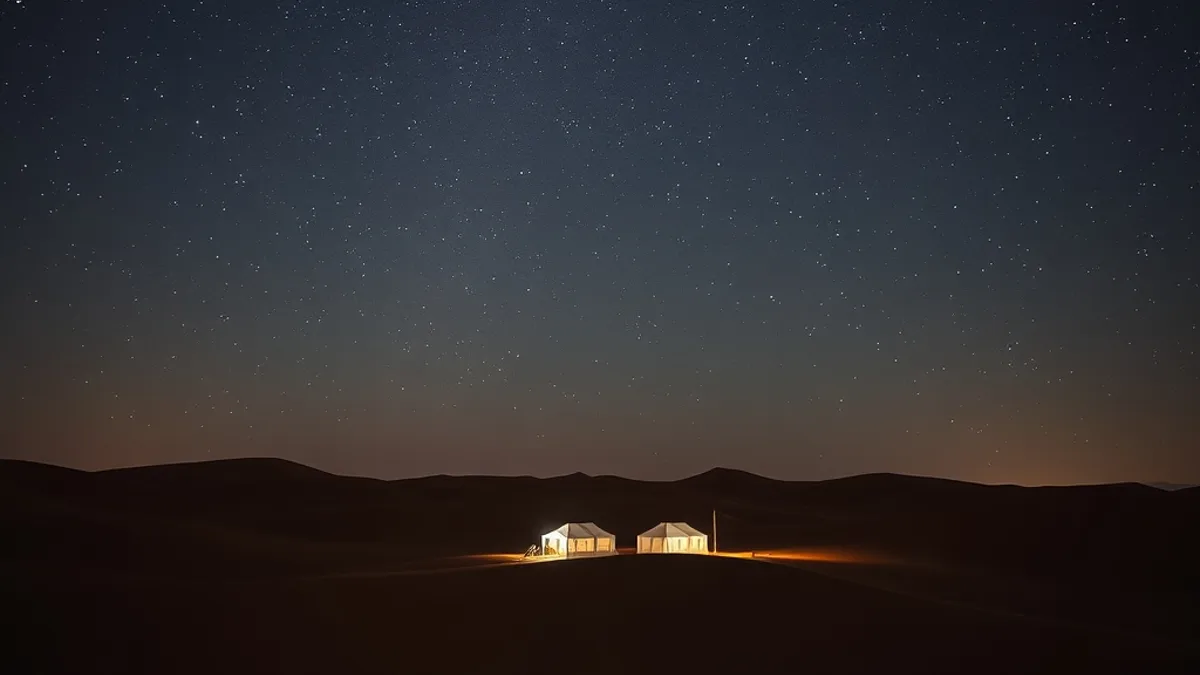
Most travelers have seen the photos: canvas tents glowing under a sky full of stars, dunes stretching to the horizon, dinner served around a crackling fire. But when it comes to actually booking glamping in the Sahara, the questions pile up fast. Which regions offer genuine luxury camps rather than a mattress on the sand? And when does the desert climate actually make an overnight stay enjoyable instead of an endurance test?
This guide answers both. We compare the main dune fields and desert regions where glamping really works, from Morocco’s most accessible dunes to quieter alternatives in Tunisia and Egypt. We break down the seasons, so you know which months offer warm days and mild nights, and which ones to avoid entirely. You’ll also find an honest look at camp types, how to spot a well-run operation, what booking and transfers involve, and what a night in camp is really like from sunset to sunrise.
Where Glamping in the Sahara Actually Works
The Sahara is enormous, but only a handful of areas combine real dune scenery with camps that can genuinely be called glamping. Choosing the right one matters more than most travelers expect, because accessibility, crowd levels and even the character of your night out there vary a lot from region to region.
Morocco: the two classic choices
Erg Chebbi, near the village of Merzouga, is the most accessible dune field in the Sahara. The dunes rise dramatically, and paved roads run all the way to the trailhead, so you can drive in from nearby towns without any off-road legwork. This ease of access makes it the busiest option, but also the simplest to organize independently or as part of a multi-day tour.
Erg Chigaga, near M’Hamid, suits travelers who want isolation instead. There is no easy road access; reaching the dunes requires a 4×4 transfer across rocky desert and flat hammada. That extra effort keeps day-tripper numbers low and gives the nights a properly remote feel.
Beyond Morocco
Tunisia offers a quieter alternative around Ksar Ghilane and Douz, where camps sit near desert oases and the pace is slower than Morocco’s main dune fields. In Egypt, the White Desert combines surreal chalk formations with Bedouin-style tented stays, giving you scenery you simply won’t find anywhere else in the Sahara.
Best Seasons for a Desert Night
The desert is a place of extremes, and the season you pick shapes your whole experience. The comfortable window for a Sahara overnight runs from October to April, when daytime highs typically sit between 20-28°C. That’s warm enough for barefoot dune walks and dinners outside, without the punishing heat that makes summer stays miserable.
March and November give the best balance of warm days and mild nights. You get the golden light and pleasant daytime temperatures of the shoulder season, plus nights that are cool but not cold enough to dominate your packing list. If your dates are flexible, aim for one of these two months first.
Winter is a different story. From December to February, nights in the open desert can drop below 5°C, and camps vary in how well they handle it. Some travelers actually enjoy the crisp winter air and emptier dunes, and a cold desert night is very different from a cold night at home, as anyone who has compared it with, say, a milder coastal stay like glamping beside the lagoons of Castel Volturno will tell you. Pack accordingly and you’ll be fine.
- Shoulder-season wind: spring and autumn can bring occasional sand-laden winds, so a light scarf or buff protects your face and keeps fine sand out of cameras and bags.
- Winter layering strategy: thermal base layers, a fleece and a windproof outer layer let you enjoy the campfire comfortably even when temperatures fall sharply after sunset.
- Day-night swings: even in the mildest months, temperatures can drop 15°C or more between afternoon and early morning, so dress in removable layers rather than one heavy coat.
- Summer alternative: if June to August is your only option, consider higher-altitude or coastal destinations instead, since tented desert camps are genuinely uncomfortable in that heat.
Types of Desert Camps to Choose From
Not all Sahara camps are the same, and the differences go far beyond price. The style of camp you choose determines your comfort level, how close you feel to traditional desert life, and how much of the experience is organized for you. Here are the four main types you’ll encounter.
Permanent luxury camps are the true glamping option. Tents stay in place year-round and come with en-suite bathrooms, real beds on proper frames, and a dining tent where meals are served. Many also add extras like lounge areas, hot showers and organized evening entertainment, so the experience feels closer to a boutique hotel than camping.
At the other end, Berber-style bivouac camps keep things simple and authentic. Facilities are usually shared, tents are more basic, and evenings often center on traditional music around the fire. If your priority is atmosphere and cultural connection rather than plumbing, this style delivers it.
- Mobile expedition camps: set up fresh each night for multi-day camel treks or 4×4 journeys, these move with your route and trade permanence for a genuine expedition feel, often with crew who cook and pitch tents while you watch the sunset.
- Eco-camps: running on solar power with composting toilets, these low-impact stays appeal to travelers who want their desert night to leave minimal trace, and they often sit in quieter spots away from the main camp clusters.
- Hybrid setups: some operators run both a luxury camp and a simpler bivouac nearby, letting you mix comfort and authenticity across a two-night stay.
Before booking, be honest about what matters to you. A private bathroom and a real mattress matter enormously to some travelers and very little to others. Knowing which camp style fits your priorities makes the rest of the planning much easier.
How to Spot a Genuinely Good Camp
Not every tent with a fairy-light strand counts as glamping, so it pays to look past the photos. Start with the basics of comfort: tents should have proper insulation against the wind, real mattresses on solid frames, and heating for winter nights or fans for the warmer shoulder months. Ask the camp directly what they use in each season, since a camp that only offers thin blankets in December is a bivouac in disguise.
Bathrooms are the clearest dividing line between true glamping and a basic desert camp. If a private en-suite bathroom matters to you, confirm it is attached to your tent, not a shared block a short walk away. This is the same principle that applies to any slow-travel stay, whether you are comparing camps in the dunes or a lakeside cabin like those described in Masurian lake glamping for slow travel: the level of privacy tells you a lot about the overall standard.
Reviews and what is actually included
Read recent reviews with a critical eye, focusing on three practical themes: how well the camp manages sand blowing into tents, the quality and variety of food, and how quickly staff respond when something goes wrong. Reviews from the same season you plan to travel are the most useful.
Finally, confirm exactly what your rate covers. Some camps include transfers from the nearest town, dinner and breakfast, plus activities such as sandboarding or guided stargazing, while others charge for each separately. Getting this in writing before you book avoids awkward surprises at check-in.
Booking, Prices and Getting There
Luxury desert camps in the Sahara typically charge roughly $100-300 per person per night, and that rate usually includes half board, meaning dinner and breakfast. The upper end of the range generally buys you larger tents, private bathrooms and a better location deeper in the dunes. Mid-range and Berber-style bivouacs sit below this, so check what category you are actually booking.
Timing matters as much as price. The high-season windows, particularly October, December and Easter weeks, fill up quickly, so booking 2-3 months ahead is a sensible rule of thumb. Last-minute availability in these periods tends to mean the least desirable tents or camps closer to town.
Getting there
Most travelers fly into Marrakech or Ouarzazate and then either drive 7-9 hours to the dune fields or, far more comfortably, join a multi-day tour that breaks the journey with stops along the way. The final leg is typically a 1-2 hour camel trek or a 4×4 transfer from the nearest town to camp.
- Ask whether the tour price includes the camel or 4×4 transfer, as some operators treat it as a separate add-on.
- If you are self-driving, confirm secure parking at the departure point, since you will leave your vehicle behind for the night.
- Multi-day tours usually bundle hotel nights en route, which can work out cheaper than arranging each leg independently.
- Check luggage limits for camel transfers; soft bags are far easier to strap on than hard-shell suitcases.
What a Night in Camp Is Really Like
The rhythm of a desert camp follows the light. Most stays begin with a sunset walk up the nearest dune, timed so you reach the crest as the sand shifts from gold to deep orange and the temperature finally starts to drop. Back at camp, dinner is usually a tagine, cooked slowly and served in a dining tent or under open skies, followed by drumming around the campfire. It sounds touristy on paper, but with a small group and good hosts it genuinely lands.
Stargazing worth planning around
With near-zero light pollution, the night sky is the main event. The Milky Way is visible to the naked eye, and even basic phone apps become surprisingly useful out here. One practical tip: check the moon phase before booking, because stargazing is best well away from the full moon, when the sky is at its darkest.
Winter nights from December to February can drop below 5°C in the open desert, and camps do provide plenty of blankets, but bringing your own thermal base layers makes a real difference to how well you sleep. Plan for early wake-ups too: sunrise over the dunes is often quieter and just as beautiful as sunset, and most stays end with breakfast and a return transfer to the nearest town before mid-morning.
Wrapping Up Your Sahara Glamping Plan
Sleeping in a proper bed under Saharan stars is not a fantasy reserved for documentary crews. Real glamping exists in several corners of the desert, and the choice mostly comes down to how much isolation you want. Erg Chebbi near Merzouga is the easy option, with paved roads most of the way, while Erg Chigaga rewards travelers willing to accept a longer 4×4 transfer with quieter dunes and fewer neighboring camps.
Timing and budget shape the rest of the plan. The cooler months are the comfortable window, and the shoulder seasons strike the best balance between warm days and nights you can actually sleep through. At the luxury end, nightly rates generally sit in the low-to-mid hundreds of dollars, with dinner and breakfast typically included in the rate. High season fills up quickly, so reserving well in advance pays off. If this helped you plan your desert night, leave a comment or share the article with a fellow traveler.