The photos look perfect, the ratings are five stars across the board, and yet something feels off. Learning how to read glamping reviews properly is the difference between a magical night under canvas and discovering too late that those “cozy” tents have paper-thin walls, that the “bathroom facilities” are a shared block down the path, or that the wide-angle shots hid how close your tent sits to the parking lot.
Glamping reviews simply work differently from hotel reviews, and they deserve a different approach. A property with a handful of detailed, recent reviews can tell you more than a resort with hundreds of vague ones. In this guide, we’ll walk through how to filter reviews by date and season, decode the photos and phrasing for red flags, check the practical details reviewers mention, and match what you read to the price and your own expectations. By the end, you’ll know how to verify what the reviews claim before you hand over a deposit.
Why Glamping Reviews Differ From Hotel Reviews
Glamping reviews behave differently from hotel reviews, and that changes how you should weigh them. Most glamping sites are small operations with fewer than 20 units, so they collect far fewer reviews than a 200-room resort. With a small sample, a single rough season — a storm-damaged tent, a sick cook, a stretch of bad weather — can drag the average down sharply, or a handful of enthusiastic guests can push it up. A 4.2 rating based on 14 reviews simply doesn’t carry the same weight as the same score based on 2,000.
The physical product also changes faster than it does at a hotel. Tents get re-roofed, mattresses replaced, wood stoves swapped out, and flooring redone between seasons. A detailed review from three years ago may describe bedding, heating or flooring that no longer exists — for better or worse. Owners often reinvest between guest seasons, so an older complaint about a cold night might already be fixed. That doesn’t make old reviews useless, but it does mean you should read them as history rather than as a current report.
Pay attention to owner responses
Because many glamping sites are family-run, with no corporate chain or management company behind them, the way an owner responds to reviews matters more than it would at a hotel chain. A host who replies to a complaint about a leaky tent with specifics — what was replaced and when — is showing you how problems actually get handled on site. Silence in the face of repeated complaints, or copy-paste apologies with no detail, tells you something too. On small sites, the reviewer and the owner are often the whole relationship, so read both sides of it.
Filter by Date and Season Before You Read Glamping Reviews
Glamping sites change fast. Tents get replaced, platforms get rebuilt, and a review from three summers ago may describe a completely different setup than the one you’ll sleep in. Before you read a single word, filter and sort by date so the most recent experiences sit at the top.
- Set your review filter to the last 12 months. Reviews written within the past year are the most reliable signal of what the site is actually like now. Older reviews can still be useful for spotting long-running patterns, but treat anything older as background rather than fact.
- Match review dates to your travel window. A glowing July review says little about an April stay. Peak season in most of Europe and North America runs May to September, so a mid-summer rave might reflect warm nights, full staffing and dry ground that simply won’t exist in shoulder season.
- Read reviews from your exact month if you can find them. Someone who stayed in late September knows what the site feels like when evenings turn cool and the season winds down. That detail matters more than a dozen peak-season five-star ratings.
- Search the review text for rainy-season keywords. Use the search box on the review page and type words like mud, condensation, cold nights and leaking. Rainy-season reviews often mention these comfort problems that dry-season reviews leave out entirely, and the hits tell you exactly what to ask the host about.
- Note which season each complaint belongs to. A review complaining about mosquitoes in August and one complaining about a cold tent in October are two different issues. Sorting by date and season keeps them from blurring together.
This filtering step pairs well with choosing the right kind of site in the first place. If you’re considering a lakeside stay, reading season-matched feedback on Masurian lake glamping for slow travel shows how much the experience shifts between a warm, busy summer month and a quiet, damp shoulder-season week. Once your reviews are filtered, everything you read becomes far more relevant to the trip you’re actually planning.
Decode the Photos and Phrasing for Red Flags
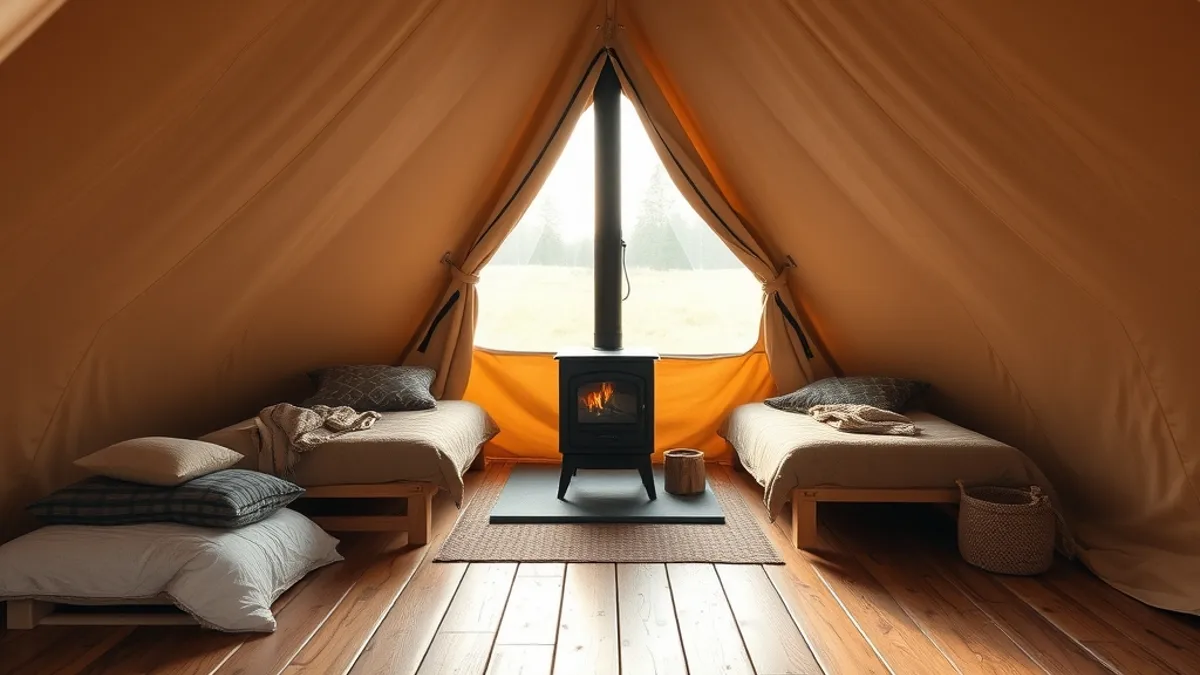
The first thing I do before reading a single word of a glamping review is open the photos side by side. Official listing shots are usually wide, golden-hour images taken from the most flattering angle possible. Reviewer photos show you what the site looks like at noon, in rain, with someone else’s tent visible a few meters away.
Look for mismatches. If the official photos show a tent facing a lake and a reviewer’s photo shows the same tent facing a gravel parking area, the photographer simply walked around until the neighbors disappeared from frame. Bathrooms deserve special attention: when the listing shows one crisp shot of a sink and reviewers mention cropping or partial views, there may be more to the room than the owner wants you to see. A candid write-up with real guest photos, like this Laghi Nabi glamping review from Castel Volturno, Italy, gives you a useful benchmark for what honest documentation looks like.
Phrasing matters just as much as imagery. Glamping owners are masters of euphemism, and once you learn the vocabulary, the warnings jump off the page.
- “Rustic charm” typically signals thin canvas walls, minimal soundproofing, and furnishings that are older or simpler than the photos suggest.
- “Back to nature” or “unplugged experience” often means no heating, no electricity in the tent, or shared bathroom blocks a short walk away.
- “Close to nature” combined with complaints about insects or dust in reviews confirms the tent is not well sealed.
- Beware clusters of five-star reviews posted within days of each other, all with similar wording and no photos — this pattern often points to incentivised or requested feedback rather than organic guests.
- Check whether five-star reviewers have any other reviews on their profile; a brand-new account whose only activity is one glowing glamping review deserves skepticism.
Check the Practical Details Reviewers Mention
The star rating tells you very little on its own. What actually predicts a good glamping stay is whether the site keeps you warm, dry, fed and reachable, so scan reviews specifically for those practical details before you get distracted by talk of views and sunsets.
Start with warmth. Canvas and cabin walls rarely insulate like a hotel room, so look for comments on insulation and how cold nights actually felt. A review that says “we slept in our clothes in June” tells you more than any amenity list. If you want a sense of how these details play out in a real stay, a detailed glamping review of a safari-style tent near Lake Powell shows the kind of specifics worth hunting for: bedding weight, night temperatures and how the tent handled wind and desert air.
Then work through the rest of the checklist. Reviews usually answer the questions marketing copy avoids, so read for these three:
- Bathroom setup: confirm whether reviewers describe a private ensuite or a shared shower block, and note if they mention hot water running out at busy times or a walk over gravel to reach it.
- Cooking arrangements: some sites allow a camp stove or fire pit at your tent, others ban open flames and only offer a communal kitchen, and a few have no self-catering at all, which matters if the nearest restaurant is a drive away.
- Distance and access: note how far reviewers say the site sits from the nearest road, shop or town, and whether they mention rough tracks, parking limits or luggage hauls, which is especially important if you are arriving without a car.
Match Reviews to Price and Expectations
A three-star review can mean very different things depending on what the guest paid. A $120 basic canvas tent gets judged against a hotel-room standard it never promised, and complaints about thin walls or a shared shower block may be accurate descriptions of a budget product rather than a bad one. Read the rate context first, then decide whether the complaint applies to your booking.
The reverse is true at the top of the market. Reviews of $300+ luxury stays tend to scrutinize service, dining and housekeeping closely, and they should. If guests at that price mention slow check-in, cold dinners or dusty floors, take those notes seriously, because at that rate the basics are the minimum, not a bonus.
Use reviewer budgets as anchors
When a reviewer mentions what they paid or what they expected for the price, treat that as your anchor. It helps you match the comfort level you actually want to the right rate band, from simple canvas at the lower end to full-service lodges at the top. A complaint from someone expecting a resort experience at a basic tent price is noise; a complaint from someone who paid luxury rates and got a basic experience is a signal.
Done this way, star ratings stop being vague and start being a real decision-making tool.
Read Reviews, Then Verify Before Booking
Reviews narrow your shortlist, but they rarely settle it. Star ratings tell you that something happened at a site; they rarely tell you why, or whether it would happen to you. The last step is a short verification round: a few direct questions to the host and a cross-check on a second booking platform. It takes under an hour, costs nothing, and catches most of the surprises that reviews alone leave behind. This matters even more with glamping, where sites under 20 units usually show fewer but more detailed reviews than large resorts, so a single unanswered question can carry extra weight in your decision.
- Message the host with specific questions. Pick two or three points the reviews raised, such as how the tent is heated in shoulder season, whether the shared bathrooms were recently renovated, or how the site handles a rainy arrival. Vague questions get vague answers, so quote the detail you want confirmed. If a reviewer mentioned condensation on cold nights, ask exactly how the site manages it.
- Judge the reply as part of the review. A host who answers quickly, concretely and honestly, including admitting a limitation, is a good sign for how your stay will be handled. Silence or a copy-paste reply is its own data point, especially at family-run sites where the person answering is usually the person on site.
- Book once your questions are answered. For May-September weekends at popular sites, plan to book 3-6 months ahead, because the best units at small sites go first and there are fewer of them to begin with.
- Cross-check before you commit. Compare recent guest photos and host answers on at least two booking platforms. If the newest photos on one platform are two years older than on another, or answers contradict each other, ask why before paying any deposit.
Once the host has confirmed the details that mattered and the platforms agree, you can book with a clear picture of what you are actually getting, not just what the listing promises. That confidence is the real payoff of the extra hour: you arrive knowing how the tent is heated, where the bathroom is and what the site does when the weather turns, so the only surprise left is how good the view is.
The Bottom Line on Booking From Reviews
So how do you separate a genuinely great glamping site from one with thin walls, shared bathrooms and flattering photos? Read past the stars. Reviews written within the last 12 months, matched to the same season as your trip, reveal the comfort details that glossy images hide: how cold the canvas gets after dark, whether the bathroom is truly private, and how long a walk or drive it takes to reach a shop or town.
From there, practical details and fair price expectations turn a vague five-star average into a real decision. A $120 basic tent and a $400+ luxury lodge should not be judged by the same standard, and reviewers who paid a similar rate will tell you which comfort level you are actually booking. Finally, a short host conversation about the questions reviews raised, plus a cross-check of recent photos and answers on two platforms, closes the remaining gaps before you commit. If this helped you sort a genuine gem from a clever listing, share it or leave a comment below.