You’ve found a lodge that looks perfect, and the listing mentions a pool. But the photos don’t tell you much: is it indoors or out? Heated or unheated? Open year-round, or drained by the time you arrive in October? Many travelers only discover these answers at check-in, when the “pool” turns out to be a seasonal outdoor basin closed for the winter or a shared spa booked out for private sessions.
That’s why lodge stays with pools deserve a little research before you book. In this guide, we break down the real differences between indoor and outdoor lodge pools, when each type is actually usable, and the practical details — heating, hours, towels, age rules — to confirm before paying. We also look at pool size and layout, booking timing and typical price differences, and which lodge types suit pool lovers best, from spa lodges to private cabins. By the end, you’ll know exactly what to ask so the pool you imagined is the pool you find.
Indoor vs Outdoor Lodge Pools: What Each Type Really Offers
The first question to ask about any lodge pool is the simplest one: is it inside or outside? The answer shapes your entire stay, because the two types serve completely different trips.
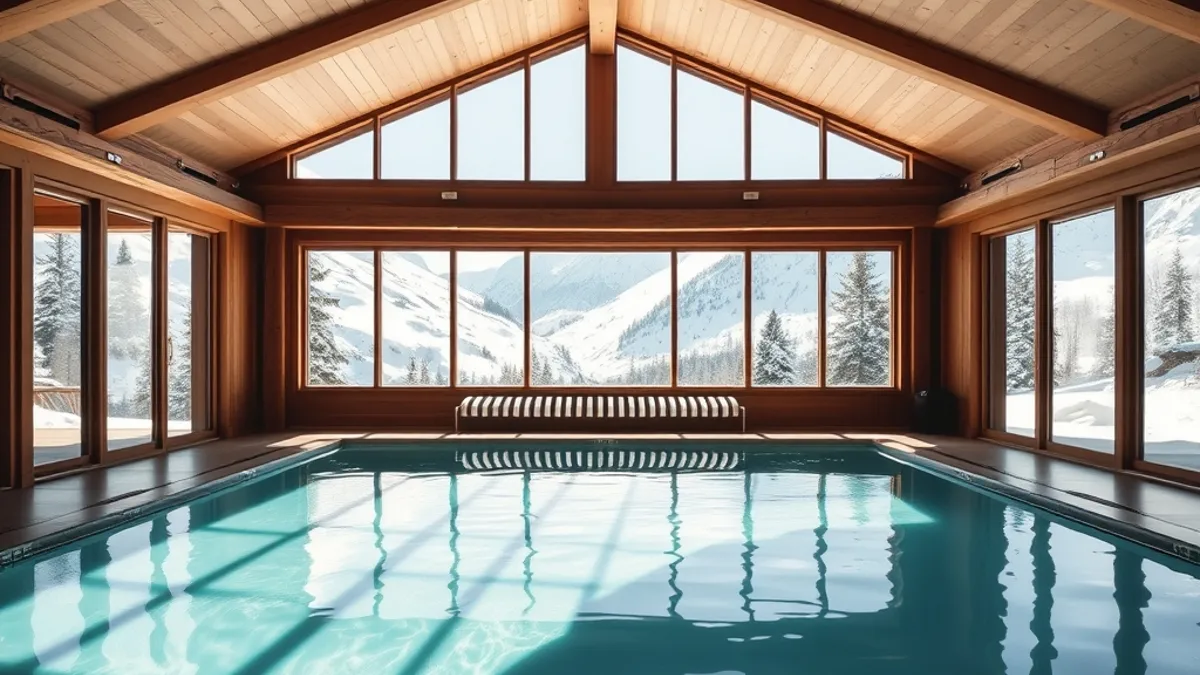
Indoor pools run year-round, which makes them the natural choice for winter ski trips or any cold-season lodge stay. The trade-off is atmosphere. Indoor pool areas can feel humid, and in smaller lodges they’re sometimes windowless rooms with little view to speak of. If you picture yourself swimming while looking at mountains, an indoor pool alone may disappoint.
Outdoor pools and the heated middle ground
Outdoor pools in mountain regions typically operate from May to September, and during those months they’re hard to beat: fresh air, open views and a swim with a scenery backdrop. The obvious downside is the calendar — outside the warm season, most simply close.
Heated outdoor pools change that equation. Upscale lodges often keep water around 28-32°C, which extends comfortable swimming into spring and autumn, and at the best of them, into winter itself. There’s also a third option: indoor-outdoor combo pools, where you can swim from inside the building straight out into the open air. These give you the best of both worlds, but they require serious infrastructure, so you’ll mostly find them at larger spa lodges rather than small, independent properties.
Season and Climate: When a Lodge Pool Is Actually Usable
A pool listed on a lodge’s website exists — but that doesn’t mean it will be open when you arrive. This is one of the most common booking mistakes, especially in mountain regions, where many alpine outdoor pools operate only from May to September. If your trip falls outside the warm months, that beautiful infinity pool on the website may be little more than an empty basin, no matter how tempting it looked in the photo gallery.
For winter trips, prioritize lodges with indoor pools or heated outdoor options if swimming is important to you. Heated outdoor pools can keep water comfortably warm even in cooler months, but not every lodge invests in this, so it pays to ask. And don’t assume shoulder season is a safe compromise: stays at the very edges of the season often come with shorter pool hours or partial closures while the lodge carries out maintenance. The pool may technically be open yet far less enjoyable than you imagined.
- Maintenance windows: many lodges schedule their annual pool drain and clean in low season, which can close the pool for a week or two — ask for the exact dates before booking.
- Heating schedules: some lodges only heat outdoor pools during peak months, so a pool that’s technically open in spring or autumn may be too cold to enjoy.
- Weather dependency: at small lodges, outdoor pools may open late or close early on cold or rainy days, since staffing a quiet pool area isn’t always worthwhile.
A quick email to the lodge asking “will the pool be open and heated during my dates?” takes two minutes and can save a disappointing stay. Get the answer in writing, and you’ll have something to fall back on if the pool turns out to be closed when you check in.
Details to Check Before Booking a Lodge Stay With a Pool
Once you know the pool exists and should be open for your dates, the next step is the fine print. This is where lodge pools vary the most, because unlike large resorts, smaller lodges often run their pool areas with minimal staffing and strict house rules. Some have no lifeguard at all, and a few expect you to note your swim in a simple sign-up sheet at reception. A handful of questions asked before booking make all the difference between a highlight of your stay and a daily letdown.
Start with heating — for outdoor pools especially, confirm the water is heated and to roughly what temperature, since an unheated mountain pool can be too cold to enjoy even on a sunny day. Then check the daily schedule: many lodges keep their pools open from around 7am to 9pm, but smaller properties sometimes reduce hours in low season or close the pool for private spa bookings, leaving guests only a few usable hours. Ask whether maintenance work is planned during your stay, too, and get any promise of full access in writing.
- Towels and facilities: pool towels, changing rooms and showers are not always included — some lodges charge separately or expect you to bring towels from your room, so ask exactly what’s covered before you pack.
- Access type: verify whether the pool is shared with all guests or reserved per room or cabin; a private bookable slot feels very different from a busy shared basin, especially if you have young swimmers.
- Age restrictions: some lodge wellness areas admit guests aged 16 or older only, which matters enormously for families — confirm the written policy if you’re traveling with children rather than relying on the website.
None of these details are dealbreakers on their own, but together they determine whether the pool actually fits your trip. A quick email listing your questions takes five minutes, and lodges that answer clearly are usually the ones that run their pool areas well. Get the answers confirmed before you pay, and you’ll sidestep the most common sources of disappointment at check-in.
Pool Size, Depth and Layout: Matching the Pool to Your Trip
Not every lodge pool works for every trip, and the biggest mismatch I see is swimmers booking a lodge based on a pretty pool photo, then finding out the pool is too small for laps or too quiet for kids. Before you book, think honestly about how you plan to use the water.
For lap swimmers and training trips
If swimming is a daily ritual rather than an occasional dip, pool length matters. Serious lap swimmers need a pool of 20 meters or more, and only larger lodge resorts typically offer that. Many smaller lodges make do with a compact pool of just 2-4 shared lanes. That is perfectly fine for cooling off after a hike or a sauna round, but it makes real training frustrating — you will be turning every few strokes. Ask the lodge for the pool’s exact dimensions before assuming you can get your workout in.
Families and soak-and-relax travelers
Traveling with children is another story. Look for a shallow children’s area or a separate kids’ pool, and check the water depth of the main pool too. These family features are rare at small adult-focused lodges, so if they matter to you, filter your search accordingly rather than hoping for the best.
For relaxation trips, a soaking pool or hot tub is often the real draw. Keep in mind that these smaller water features frequently require advance reservation slots, especially at busy times. If a private soak is the highlight of your stay, book the slot as early as the lodge allows instead of leaving it to chance on arrival day.
Booking Timing and Price for Lodge Stays With Pools
Pools add real cost to a lodge, and that shows up in both rates and availability. A little timing strategy goes a long way here.
When to book
For summer weekends, book 2-4 months ahead. Pool lodges fill quickly in the warm season, and pool-facing rooms sell out first — the guests who book early are the ones who get the view and the shortest walk to the water. If you wait until a few weeks out, expect either a premium price or a room at the far end of the property.
Your dates also affect the price. Midweek stays in shoulder season often cut rates while keeping full pool access, so a Tuesday arrival in late spring or early fall can get you the same facilities for noticeably less than a Friday night in July. If your schedule is flexible, this is the easiest saving available.
What you will pay
As a rule of thumb, expect a price premium of roughly 10-25% over comparable lodges without pool facilities. That covers heating, maintenance and often the spa areas around the pool. One thing to check carefully: some lodges bundle pool and spa access into a separate resort fee rather than the room rate. Ask whether access is included, and what the fee covers, so the final bill does not surprise you at checkout.
Best Lodge Types for Pool Lovers: Spa Lodges, Resorts and Cabins
The type of lodge you choose shapes the pool experience more than any single feature does. A spa lodge pool and a cabin plunge pool are barely the same product, so start by matching the lodge category to the trip you actually want.
Destination spa lodges are the safest bet for dependable swimming. They almost always include year-round indoor pools along with thermal facilities like saunas and steam rooms, so weather and season barely matter to your stay. National park lodges work differently: they lean toward seasonal outdoor pools, which pairs beautifully with a summer hiking trip — a dip with a forest or mountain backdrop after a long trail day is hard to beat.
- Spa lodges: these properties often add extras like whirlpool stations, cold plunge basins and wellness treatment rooms directly adjacent to the pool area, so a single visit can fill half a day.
- National park lodges: outdoor pools here often sit in scenic, open-air settings, and lounge space around the pool tends to be generous, but expect the pool to be closed and quiet outside the warm season.
- Private cabins with plunge pools: you get complete privacy, but these pools usually lack lifeguards, heating guarantees or daily cleaning — small plunge pools can cool down quickly and may need a top-up or skim during a longer stay.
- Ski lodges with heated outdoor pools: heated water around 28-32°C lets you swim while snow falls around you, a signature alpine experience, and steam rising off the water on a cold evening is as memorable as the skiing itself.
Whichever category you choose, the details still matter. Confirm heating, cleaning schedules and any age rules before booking, since the lodge type only tells you what is typical, not what is guaranteed at the specific property.
Wrapping Up Your Lodge Pool Search
A pool photo tells you almost nothing on its own. The details that matter — indoor or outdoor, heated or seasonal, shared or private — are exactly the ones listings tend to hide. That gap between the picture and reality is what leads to most pool-related disappointments on arrival.
The fix is to plan around the pool, not just the lodge. If swimming is a priority, choose an indoor pool for guaranteed year-round access, or an outdoor one if your trip falls within the May-September window in mountain regions. Before you commit, verify heating, opening hours, towel access and any age rules directly with the property, and match the pool type — lap, family, soak or plunge — to the trip you actually have in mind.
Timing matters too. Pool-facing rooms at popular lodges go quickly in the warm season, so securing your reservation well in advance for a summer weekend is a smart move, and it helps to budget for a modest premium over lodges without pool facilities.
Have a question or a lodge pool story of your own? Leave a comment or share this article.