You booked a dreamy glamping escape months ago, and now the forecast shows days of rain. The question isn’t just whether to cancel—it’s whether glamping in rain can actually be enjoyable, or whether you’re setting yourself up for a soggy, miserable weekend. The honest answer: it depends almost entirely on how well you plan.
Rain changes a glamping trip in ways hotels never have to worry about, from muddy access paths to condensation dripping off a dome’s ceiling. But with the right structure, the right season and a flexible booking, wet weather can become atmosphere instead of a disaster. This guide walks through what rain really does to a site, how to choose accommodation that shrugs it off, which seasons and destinations keep rain manageable, how to book and pack smart, and how to build an itinerary that survives a downpour.
What Rain Really Does to a Glamping Trip
Persistent rain doesn’t usually ruin a glamping trip in one dramatic moment. It works gradually: access paths turn to mud, bedding picks up that faint damp smell, and condensation forms on tent and dome walls as warm breath meets cold fabric. By the second or third day, everything can feel faintly wet if the site wasn’t designed for it.
When downpours flood a site
Heavy rain is a different problem altogether. Sites set in low-lying fields or near streams can see standing water around tents, and a bell tent on grass quickly becomes a bell tent in a puddle. This is why elevation and drainage matter more than star ratings when you’re comparing properties. A modest site on a slope with gravel paths will outperform a fancier one in a flood-prone hollow every time.
The wind chill factor
Cold rain combined with wind drops the perceived temperature sharply. A forecast showing 15°C can feel closer to single digits inside a thin-walled tent, especially after dark. That mild afternoon reading tells you very little about how the night will actually feel, which is why insulation and heating deserve as much attention as waterproofing when you book.
Choosing Rain-Proof Accommodation Types
The structure you sleep in makes the biggest difference between a rainy trip you remember fondly and one you remember for the wrong reasons. Domes, cabins and safari tents with hard floors and raised platforms handle wet ground far better than bell tents pitched directly on grass. A raised platform keeps you above surface water, while a hard floor means no mud tracked into your sleeping area and nowhere for damp to seep up from below.
Fabric quality matters too. Quality glamping tents use waterproof fabrics rated around 3,000-5,000 mm hydrostatic head, and the seams should be taped rather than just stitched. Stitched seams let water wick through thread holes during long rain, so it’s a fair question to ask any host before you book.
The features that turn a wet day into a cozy one are often the ones listed last in the description: a covered veranda where you can sit outside without getting soaked, a wood stove or heater for damp evenings, and an indoor lounge so you’re not confined to the bed all day. Sites like the one in this glamping review from Combe Martin in the United Kingdom show how much these details shape the experience when the weather turns.
Before booking, ask hosts a few pointed questions:
- Drainage: where water goes during heavy rain, and whether any units have pooled water around them in the past.
- Path surfacing: whether walkways are gravel, boardwalk or grass, since that determines how usable the site is after a downpour.
- Lighting and cover: whether paths between your unit and the bathroom or lounge are lit and covered for nighttime trips in the rain.
Picking Seasons and Destinations Where Rain Is Manageable
Timing does more to control your rain risk than any piece of gear. In temperate Europe, the wettest stretch runs from October to February, so aim for May-June or September instead. Those windows give you long daylight hours and warmer ground, and showers tend to pass rather than settle in for a week. If you want a taste of what a well-chosen shoulder-season site looks like, this glamping review from Terras de Bouro in Portugal sits in a green, rainy corner of the Mediterranean where timing makes all the difference.
Why shoulder season pays off
There’s a financial upside to gambling on the edges of the season. Shoulder-season stays often cost 20-40% less than peak summer rates, which offsets the rain gamble nicely. Even if you lose one afternoon to a downpour, the savings and thinner crowds make the trade feel reasonable.
Where rain falls differently
Destination type matters as much as the calendar. Mediterranean and coastal sites typically see shorter showers rather than week-long fronts outside winter, so a rainy hour is an inconvenience, not a write-off. Mountain and inland sites behave differently and can hold cloud for days.
Before booking, check regional monthly rainfall averages rather than relying on the 10-day forecast. A long-range forecast tells you about one specific week; monthly averages tell you what the destination is actually like in that season, which is the information you need when committing months ahead.
Booking Smart: Timing and Flexibility
Glamping in the shoulder season rewards travelers who book with a plan rather than on impulse. The good news is that you don’t need insider contacts to lock in a rain-ready stay. You need the right timing, the right cancellation terms and a short conversation with the host before you pay. None of these steps takes more than a few minutes, and together they make the difference between a trip that shrugs off wet weather and one that gets washed out.
- Reserve 2-3 months ahead for shoulder-season dates. This window hits the sweet spot: weather-resilient sites like domes and cabins with stoves are in demand, but availability is still flexible enough that you can often choose your exact unit and platform rather than taking what’s left. It also gives hosts time to prepare for your arrival, especially if you flag any concerns in advance.
- Choose bookings with free cancellation up to 7-14 days before arrival. Long-range forecasts are unreliable further out, so this buffer lets you watch the outlook and walk away without losing money if a week of heavy rain shows up on the radar. Just note that cancellation windows vary by property, so confirm the exact policy in writing before you pay the deposit.
- Message the host before booking. Ask directly whether the unit has a wood stove or heater, insulated walls or a hard roof, and how the paths drain after heavy rain. Hosts who answer clearly and specifically are usually the ones whose sites genuinely handle wet weather. Vague or evasive replies are worth treating as useful information too.
It also helps to read a detailed account of a property before committing. A review like our stay at a lakeside glamping site in Castel Volturno, Italy shows the kind of practical details worth confirming: how the structures sit on the ground, what the walkways are like after rain and how the space feels when the weather turns. Photos can hide a soggy approach path, but a first-hand write-up usually will not. Ten minutes of this kind of homework is the cheapest insurance you can buy for a rainy-season trip, and it often answers questions hosts themselves overlook.
Packing for Wet-Weather Glamping
Glamping means you don’t have to haul a tent, stove or sleeping pad, but wet weather still punishes bad packing. The difference between a soggy, miserable evening and a cozy one usually comes down to a few deliberate choices in your bag. Pack as if everything you own will get damp at some point, because on a rainy trip, it probably will.
Start with your feet and your outer layers, since those take the brunt of any weather. Then think about how you’ll keep dry things dry, because a soaked duffel bag can undo even the best gear. Finally, remember that rain shrinks your evenings: you’ll spend more hours inside your dome or cabin than you planned, and boredom sets in fast after dark.
- Waterproof jacket and trousers. A rain jacket alone isn’t enough if you’re walking muddy paths to a shared bathroom; waterproof trousers keep the lower half dry and make short walks genuinely comfortable instead of a dash between shelters.
- 2-3 pairs of spare shoes or boots. Rotate them so one pair is always drying by the stove or heater while you wear another; waterproof boots for outdoors plus a dry indoor pair covers nearly every situation.
- Quick-dry towels and dry bags. A couple of quick-dry towels handle wet hair, damp dogs and muddy gear, while dry bags keep phones, cameras, passports and chargers protected inside a bag that has sat on a wet floor.
- Merino base layers. Merino insulates even when damp and resists the sour smell that wet cotton develops, so a merino set is far more useful than extra t-shirts on a rainy trip.
- Entertainment for tent-bound evenings. Download films before you lose signal, pack a deck of cards and bring a headlamp per person so nobody is fumbling in the dark when the site lights are dim.
One last habit worth building: repack dry items into their dry bags every morning rather than leaving them loose. It takes a minute and means that whenever a downpour hits, your essentials are already protected.
Building a Rain-Proof Itinerary
A rain forecast doesn’t have to flatten your plans; it just changes how you structure them. The travelers who enjoy wet-weather glamping are the ones who stop treating rain as a cancellation and start treating it as a scheduling variable. With a little flexibility, the wettest day of your trip can end up being the most memorable.
One anchor per day, with backups nearby
Plan a single anchor activity for each day, whether that’s a hike, a boat trip or a village visit, and treat everything else as flexible. Around that anchor, keep indoor backups like a spa, a museum or a covered market within a 30-60 minute drive of your site. If the morning looks grim, you swap in the backup without losing the day; if the sky clears, you’re already out the door.
Timing matters as much as the plan itself. Schedule hikes and outdoor tours for the morning, when showers in mountain and coastal areas are usually lighter, and leave afternoons loose. That way a passing shower catches you at breakfast rather than halfway up a trail.
Make the rain part of the plan
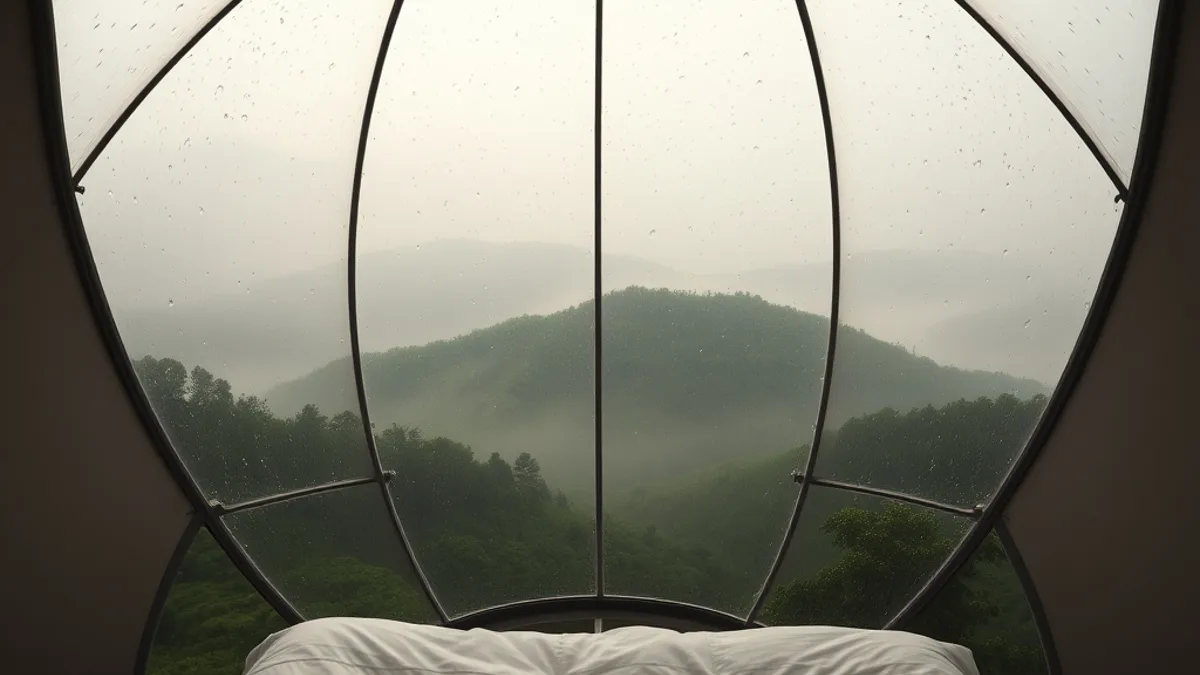
Some of the best glamping moments only happen when it rains. A wood-fired hot tub steaming under a gray sky, or lying in bed watching drops slide across a dome skylight, is exactly the kind of experience a hotel room can’t offer. Build in at least one unhurried afternoon at your accommodation and let the weather be the entertainment instead of fighting it. Travelers who plan for that downtime rarely feel shortchanged by a wet forecast; they come home talking about it as the highlight.
The Takeaway: Rain Is a Planning Problem, Not a Dealbreaker
So the forecast shows days of rain and your dreamy glamping escape suddenly feels like a gamble. Don’t cancel yet. Rain is a planning problem, not a dealbreaker, and it comes down to three smart decisions: where you sleep, when you go and how flexible your reservation is. Get those right and a wet week turns from a threat into a backdrop.
With raised platforms keeping you off soggy ground, waterproof gear keeping you dry, and indoor backups keeping everyone entertained, wet weather becomes atmosphere instead of a ruined trip. There’s something genuinely cozy about rain drumming on a dome while you stay warm inside.
If you’ve glamped through a storm, tell us how it went in the comments, or share this article with a friend who’s watching a rainy forecast right now.